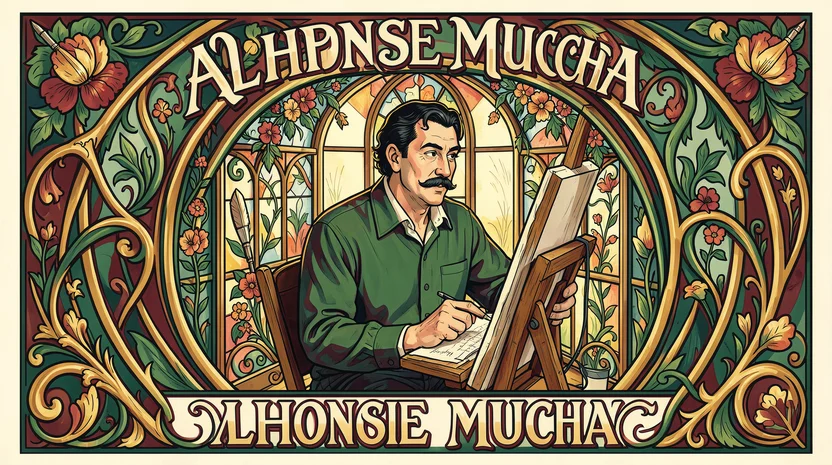
Alphonse Mucha
About this quiz
This quiz about Alphonse Mucha features 10 questions. It was generated by one of our users February 24, 2026.
Step right up, art enthusiasts and lovers of all things beautiful! Prepare to be whisked away to the Belle Époque, a time of vibrant creativity and dazzling style. Today, we're diving into the world of a true master, an artist whose iconic posters and decorative works became synonymous with elegance and charm. His distinctive flowing lines, stylized floral motifs, and captivating female figures adorned everything from advertisements for fine jewelry to theatrical playbills, leaving an indelible mark on the visual landscape of his era and beyond.
This renowned Czech painter and decorative artist, whose name echoes with artistic flair, is none other than Alphonse Mucha. He was a pivotal figure in the Art Nouveau movement, a style that celebrated organic forms and a sense of flowing harmony. Mucha's genius lay in his ability to elevate everyday advertising into exquisite works of art, imbuing them with a dreamlike quality that continues to enchant viewers. Get ready to test your knowledge of this celebrated artist and his enduring legacy!
Alphonse Mucha: The Master of Art Nouveau
Alphonse Mucha (1860-1939) was a Czech painter, illustrator, and decorative artist who became one of the most celebrated figures of the Art Nouveau movement. His distinctive style, characterized by flowing lines, organic forms, and idealized female figures, graced everything from posters and advertisements to jewelry and interiors. Mucha's work not only defined an era but also continues to inspire and captivate audiences today.
I. Early Life and Artistic Beginnings
Birth and Background: Born in Ivančice, Moravia (now the Czech Republic), Mucha's early life was marked by a deep appreciation for nature and a burgeoning artistic talent. He was exposed to folk art and music from a young age, which would later influence his decorative style.
Early Struggles and Education: Mucha initially found it difficult to secure formal art training. He worked as a decorator and was even rejected by the Academy of Fine Arts in Prague. Undeterred, he moved to Vienna to work in theatrical scenery painting, where he gained valuable technical skills.
Parisian Dream: The allure of Paris, the artistic capital of the world, beckoned. In 1887, Mucha finally made his way to Paris, a city teeming with artistic innovation and opportunity. He enrolled in art academies, including the Académie Julian and the Académie Colarossi, and immersed himself in the vibrant Parisian art scene.
II. The Breakthrough: The Sarah Bernhardt Phenomenon
The Unexpected Commission: Mucha's career took a dramatic turn in 1894 when he was commissioned to create a poster for the legendary actress Sarah Bernhardt's production of Gismonda. This commission was a stroke of luck, as the original artist fell ill, and Mucha stepped in at the last minute.
A New Visual Language: Mucha's poster for Gismonda was unlike anything seen before. It featured a striking portrait of Bernhardt, adorned with elaborate floral motifs and flowing drapery, all rendered in his unique, sinuous style. The poster was an instant sensation, captivating the Parisian public and establishing Mucha as a leading figure in poster design.
The "Mucha Style": The success of the Gismonda poster led to a cascade of commissions for Bernhardt and other prominent figures. This period solidified the key elements of what would become known as the "Mucha Style":
- Idealized Female Figures: Often depicted with long, flowing hair, serene expressions, and a sense of ethereal grace.
- Organic and Floral Motifs: Intricate and stylized representations of flowers, leaves, and vines, symbolizing nature's beauty and vitality.
- Decorative Borders and Patterns: Elaborate, often geometric or curvilinear, borders that framed the central image and added a rich decorative quality.
- Harmonious Color Palettes: Typically muted and harmonious, with a focus on pastel shades and gold accents, creating a sense of luxury and refinement.
- Calligraphic Typography: Distinctive, often flowing, lettering that complemented the artwork and was an integral part of the overall design.
III. The Zenith of Art Nouveau: Posters, Advertisements, and Decorative Arts
The Golden Age of Posters: The late 19th and early 20th centuries were a golden age for poster art, and Mucha was at its forefront. His posters for theatrical productions, advertisements for products like JOB cigarettes, Lefèvre-Utile biscuits, and even bicycles, became highly sought after. They were not just advertisements but works of art that elevated everyday commerce.
Beyond Posters: Mucha's artistic reach extended far beyond posters. He designed:
- Jewelry: Exquisite pieces often featuring enamelwork, semi-precious stones, and flowing, organic designs.
- Book Illustrations: Captivating illustrations for books and magazines, bringing literary works to life with his distinctive style.
- Interior Design: He contributed to the design of interiors, including cafes and shops, creating immersive artistic environments.
- Textiles and Wallpaper: His decorative patterns found their way onto fabrics and wallpaper, bringing Art Nouveau aesthetics into homes.
The "Belle Époque" Aesthetic: Mucha's work became synonymous with the "Belle Époque" (Beautiful Era), a period of optimism, prosperity, and artistic flourishing in Europe. His art embodied the era's fascination with beauty, sensuality, and refined living.
IV. The Slavic Epic and Later Years
A Deeper Purpose: As Mucha's fame grew, he began to feel a deeper calling to celebrate his Czech heritage. He became increasingly involved in Pan-Slavism, a movement advocating for the unity of Slavic peoples.
The Slavic Epic: This monumental undertaking became the central focus of his later life. The Slav Epic is a series of 20 large canvases depicting the history and mythology of the Slavic people. Mucha worked on this epic series for over 18 years, from 1910 to 1928, pouring his heart and soul into its creation. The series is a powerful testament to his patriotism and his desire to preserve and promote Slavic culture.
Later Life and Legacy: After the completion of the Slav Epic, Mucha continued to work, though his focus shifted. He designed the new currency for Czechoslovakia and remained an active figure in the art world. He passed away in 1939, shortly after the Nazi invasion of Czechoslovakia.
V. Key Characteristics of Mucha's Art
The Femme Nouvelle (New Woman): Mucha's female figures are often seen as embodying the "Femme Nouvelle" – a modern, independent, and idealized woman. They are not mere objects of desire but possess an inner strength and grace.
Symbolism and Allegory: His works are often rich in symbolism, with flowers, fruits, and other natural elements carrying deeper meanings. He frequently employed allegorical figures to represent abstract concepts.
Harmony and Balance: Mucha's compositions are meticulously balanced, with a harmonious interplay of lines, shapes, and colors. There is a sense of order and tranquility in his designs.
Decorative Emphasis: While his works are deeply artistic, the decorative aspect is paramount. He believed that art should bring beauty and joy into everyday life.
Influence on Design: Mucha's influence on graphic design, illustration, and decorative arts is immeasurable. His style has been emulated by countless artists and continues to be a source of inspiration.
VI. Notable Works
Posters:
- Gismonda (1894)
- La Dame aux Camélias (1896)
- Job Cigarettes (1896-1898)
- Sarah Bernhardt as La Tosca (1899)
- Lefèvre-Utile Biscuits (various)
- Moët & Chandon Champagne (various)
The Slavic Epic (1910-1928): A series of 20 monumental canvases depicting Slavic history.
Decorative Panels:
- The Seasons (series)
- The Flowers (series)
- The Arts (series)
VII. Mucha's Enduring Legacy
Alphonse Mucha's art remains as relevant and captivating today as it was during his lifetime. His ability to infuse commercial art with profound beauty and his dedication to celebrating his heritage have cemented his place as a true master. His work continues to inspire graphic designers, illustrators, and artists across the globe, reminding us of the power of art to elevate, inspire, and bring beauty into our lives.
Study Questions:
- What were the key elements that defined Alphonse Mucha's distinctive artistic style?
- How did the commission for Sarah Bernhardt's Gismonda poster change the course of Mucha's career?
- Beyond posters, what other forms of decorative art did Mucha contribute to?
- What was the significance of the Slav Epic in Mucha's life and artistic output?
- In what ways does Mucha's work embody the spirit of the "Belle Époque"?
- Discuss the concept of the "Femme Nouvelle" as it relates to Mucha's depictions of women.
- How has Alphonse Mucha's work influenced subsequent generations of artists and designers?
This study material aims to provide a comprehensive yet engaging overview of Alphonse Mucha's life, work, and enduring legacy. Feel free to expand on any section or delve deeper into specific works or themes. Happy studying!