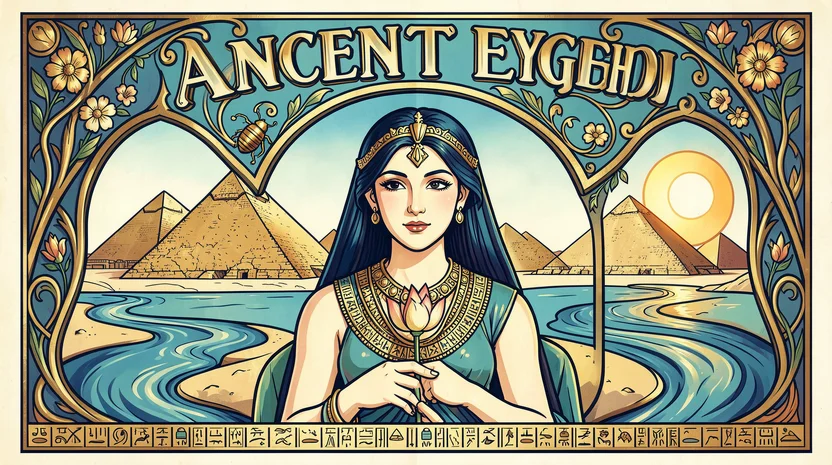
Ancient Egypt
Similar Quizzes
About this quiz
This quiz about Ancient Egypt features 10 questions. It was generated by one of our users February 14, 2026.
Welcome to Ancient Egypt: Land of Pharaohs and Pyramids!
Step back in time over 5,000 years to one of history's most fascinating civilizations! Ancient Egypt, the gift of the Nile River, flourished along the banks of this mighty waterway for nearly three millennia. From the towering pyramids of Giza to the golden treasures of Tutankhamun's tomb, this remarkable civilization has captivated our imagination for centuries. The ancient Egyptians weren't just pyramid builders—they were master engineers, skilled physicians, brilliant mathematicians, and artistic geniuses who created a complex society that would influence the world for generations to come.
Picture a land where pharaohs were considered living gods, where massive monuments reached toward the heavens, and where the afterlife was so important that people spent their entire lives preparing for it. Ancient Egyptians gave us hieroglyphics—one of the world's earliest writing systems—along with incredible advances in medicine, astronomy, and architecture. They mastered the art of mummification, built temples that still stand today, and created a calendar system remarkably similar to our own. From the legendary Cleopatra to the boy king Tutankhamun, from the Great Sphinx to the mysterious Book of the Dead, Ancient Egypt offers endless wonders to explore.
Ready to test your knowledge about this extraordinary civilization? Let's see how much you know about the land of the pharaohs!
Ancient Egypt: A Journey Through Time and Civilization
Welcome to an exploration of one of history's most fascinating and enduring civilizations: Ancient Egypt. For over three millennia, this land of pharaohs, pyramids, and powerful deities shaped the course of human history. Let's delve into some of its most remarkable aspects.
1. The Enigmatic Art of Mummification
What was the primary purpose of the elaborate mummification process in ancient Egypt?
The primary purpose of the elaborate mummification process in ancient Egypt was to preserve the body for the afterlife. Egyptians believed that the soul, or "ka," needed a recognizable physical vessel to return to and inhabit in the next world. They envisioned the afterlife as a continuation of earthly life, and thus, a well-preserved body was crucial for a successful transition and eternal existence. Mummification was a complex ritual that involved removing internal organs, drying the body with natron salt, and wrapping it in linen bandages. This meticulous process was believed to ensure the deceased's journey and comfort in the realm of Osiris.
2. The Heretic Pharaoh
Which pharaoh is famous for temporarily changing Egypt's religion from polytheism to monotheism?
The pharaoh famous for temporarily changing Egypt's religion from polytheism to monotheism was Akhenaten. Originally known as Amenhotep IV, he instigated a radical religious revolution around 1350 BCE. He abandoned the traditional worship of multiple gods in favor of the Aten, the sun disc, as the sole supreme deity. This period, known as the Amarna Period, saw a shift in art, architecture, and religious practices, but Akhenaten's monotheistic reforms were largely reversed after his death by his successors, who restored the traditional polytheistic order.
3. Engineering Marvels of the Giza Plateau
What sophisticated technique did ancient Egyptian architects use to make the Great Pyramid's base nearly perfectly level?
Ancient Egyptian architects employed a remarkably sophisticated technique involving water and surveying to make the Great Pyramid's base nearly perfectly level. They would excavate a shallow trench around the intended base area and then fill it with water. By marking the water level on the exposed bedrock, they could then carefully chip away any higher sections until they all reached the same level as the water's surface. This method, combined with meticulous astronomical observations for alignment, demonstrated an advanced understanding of geometry and engineering.
4. The Sacred Script: Hieroglyphs
What was the ancient Egyptian writing system called that used pictures and symbols?
The ancient Egyptian writing system that used pictures and symbols was called hieroglyphs. The word "hieroglyph" itself means "sacred carving" in Greek, reflecting its initial use in religious texts and monumental inscriptions. This complex system consisted of hundreds of signs, which could represent sounds, objects, or abstract ideas. Over time, simpler cursive forms like hieratic and demotic script developed for everyday use, but hieroglyphs remained the most iconic and revered form of Egyptian writing.
5. The Lifeblood of Egypt: The Nile River
Which river was absolutely essential to ancient Egyptian civilization?
The Nile River was absolutely essential to ancient Egyptian civilization. It was the lifeblood of the land, providing fertile soil through its annual floods, water for irrigation, and a vital transportation route. The predictable inundation of the Nile deposited rich silt, creating a narrow band of arable land along its banks in an otherwise arid desert. Without the Nile, the sophisticated civilization of ancient Egypt, with its agriculture, trade, and monumental achievements, would have been impossible.
6. The Papyrus Revolution
What material did ancient Egyptians primarily use to make paper-like writing surfaces?
Ancient Egyptians primarily used the papyrus plant to make their paper-like writing surfaces. The pith of the papyrus stem was cut into thin strips, layered, and pressed together. The natural sap of the plant acted as an adhesive, and the sheets were then dried in the sun. This innovation provided a lightweight, portable, and durable medium for writing, record-keeping, and the dissemination of knowledge, playing a crucial role in the administration and cultural development of ancient Egypt.
7. The Divine Protector: Wadjet
Which goddess was considered the protector of the pharaoh and often depicted with a cobra on the royal crown?
The goddess considered the protector of the pharaoh and often depicted with a cobra on the royal crown was Wadjet. Wadjet was one of the earliest Egyptian deities and was also associated with Lower Egypt. The cobra, a symbol of her power and authority, was known as the "uraeus." This symbol was worn on the pharaoh's crown as a potent emblem of royal power, divine protection, and the pharaoh's authority over both the living and the dead.
8. The Seat of Power: Memphis
What was the name of the ancient Egyptian capital during the Old Kingdom period?
The name of the ancient Egyptian capital during the Old Kingdom period was Memphis. Founded by King Menes (Narmer) around 3100 BCE, Memphis served as the political and religious center of Egypt for over a thousand years. It was strategically located near the apex of the Nile Delta, allowing for control of both Upper and Lower Egypt. Its importance is evident in the numerous temples, palaces, and royal burial sites found in and around the city.
9. The Heart of the Matter: The Heart
Which internal organ was the only one typically left inside the body during mummification?
The heart was the only internal organ typically left inside the body during mummification. Ancient Egyptians believed that the heart was the seat of intelligence, emotion, and memory. It was not removed because they believed it would be weighed against the feather of Ma'at (truth and justice) in the afterlife. The other major organs (lungs, liver, stomach, and intestines) were removed, preserved separately in canopic jars, and often placed back in the tomb. The brain, however, was usually discarded.
10. Navigating the Afterlife: The Book of the Dead
What was the primary function of the ancient Egyptian Book of the Dead?
The primary function of the ancient Egyptian Book of the Dead was to guide the deceased through the perilous journey of the afterlife and ensure their successful passage into the realm of the gods. It was not a single book but a collection of spells, prayers, hymns, and magical texts written on papyrus scrolls. These texts provided the deceased with the knowledge and incantations needed to overcome obstacles, answer the questions of the gods, and ultimately achieve eternal life and a favorable judgment in the Hall of Two Truths.
This is just a glimpse into the rich tapestry of Ancient Egypt. Each of these aspects represents a deep dive into their beliefs, ingenuity, and enduring legacy. Keep exploring, and you'll uncover even more wonders from this extraordinary civilization!