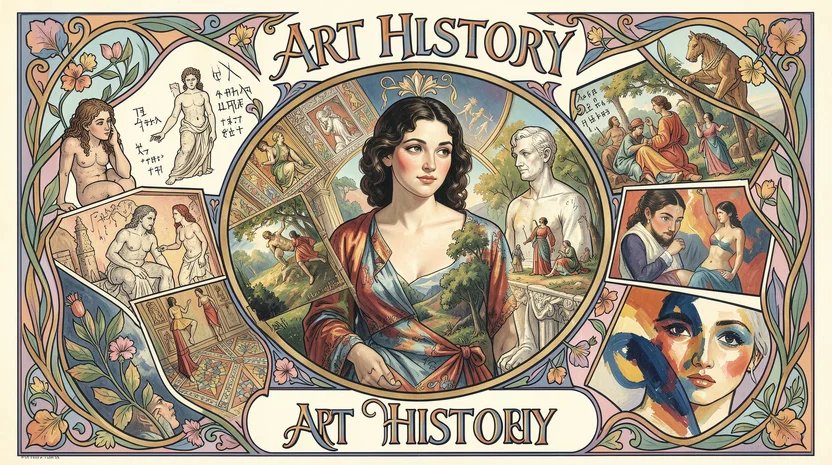
Art History
About this quiz
This quiz about Art History features 10 questions. It was generated by one of our users February 24, 2026.
Welcome, art enthusiasts and curious minds, to a journey through the ages! Art history isn't just about memorizing dates and names; it's a vibrant narrative woven from human creativity, ambition, and the ever-changing world around us. From the earliest cave paintings that whispered secrets of our ancestors to the bold, abstract expressions of the modern era, art has served as a mirror, reflecting our beliefs, our struggles, and our dreams. This quiz invites you to explore this captivating discipline, testing your knowledge of iconic movements, influential artists, and the profound stories that art tells.
Think of art history as a grand detective story, where each masterpiece, sculpture, or architectural marvel offers clues to understanding different cultures, social structures, and the very evolution of human thought. Whether you're drawn to the dramatic chiaroscuro of the Renaissance, the vibrant hues of Impressionism, or the thought-provoking installations of contemporary art, there's a universe of discovery waiting. Prepare to delve into the visual language that has shaped our world and continues to inspire us, one brushstroke, chisel mark, or digital pixel at a time. Let the quiz begin, and may your appreciation for the visual arts flourish!
Art History: A Journey Through Time and Creativity
Welcome to this comprehensive study material on Art History! We'll embark on a fascinating journey, exploring some of the most significant periods, movements, and masterpieces that have shaped our visual world. Get ready to be inspired!
Ancient Wonders: The Dawn of Civilization and Art
Which ancient civilization is famous for its monumental pyramids and hieroglyphic writing?
The answer is Ancient Egypt.
- Pyramids: These colossal structures, most famously the pyramids of Giza, served as tombs for pharaohs and were built with incredible precision and scale, reflecting their advanced knowledge of engineering and architecture. They are enduring symbols of Egyptian power and belief in the afterlife.
- Hieroglyphic Writing: This complex system of pictorial symbols was used for religious texts, historical records, and administrative purposes. Hieroglyphs offer invaluable insights into the beliefs, daily life, and history of ancient Egyptians.
The Renaissance: A Rebirth of Art and Ideas
The Renaissance, a period of great artistic and intellectual rebirth, is most closely associated with which country?
The Renaissance is most closely associated with Italy.
- Birthplace of the Renaissance: Italy, particularly cities like Florence, Rome, and Venice, became the cradle of this transformative period. Fueled by a renewed interest in classical Greek and Roman antiquity, Italian artists, thinkers, and patrons fostered an explosion of creativity.
- Key Features: The Renaissance saw a shift from the religious focus of the Middle Ages to a greater emphasis on humanism, individualism, and the study of the natural world. This led to advancements in painting, sculpture, architecture, literature, and science.
Masters of the Renaissance: Unveiling Iconic Works
Who painted the iconic 'Mona Lisa'?
The iconic 'Mona Lisa' was painted by Leonardo da Vinci.
- Leonardo da Vinci: A true Renaissance polymath, Leonardo was not only a brilliant painter but also a scientist, inventor, and anatomist. His meticulous observation of the human form and his mastery of techniques like sfumato (a soft, hazy effect) contributed to the enigmatic beauty of the 'Mona Lisa'.
- The Enigma: The 'Mona Lisa' continues to captivate viewers with its sitter's mysterious smile and the artist's masterful rendering of light and shadow. It is arguably the most famous painting in the world.
Impressionism: Capturing the Fleeting Moment
Which art movement, emerging in the late 19th century, focused on capturing fleeting moments and the effects of light and color?
This art movement is Impressionism.
- Key Characteristics: Impressionist painters sought to depict the sensory impression of a scene rather than a detailed, realistic representation. They often worked en plein air (outdoors) to capture the transient effects of sunlight and atmosphere.
- Technique: Visible brushstrokes, a focus on color over line, and compositions that often cropped elements like photographs were hallmarks of Impressionism. Artists like Monet, Renoir, Degas, and Pissarro were prominent figures.
Surrealism: The Realm of Dreams and the Unconscious
Which artist is considered a leading figure of the Surrealist movement, known for his melting clocks in 'The Persistence of Memory'?
This artist is Salvador Dalí.
- Salvador Dalí: A flamboyant and eccentric genius, Dalí was a central figure in the Surrealist movement. His work explored the irrational, the subconscious, and the dream world.
- 'The Persistence of Memory': This iconic painting, with its melting clocks draped over a barren landscape, has become synonymous with Surrealism. It evokes a sense of distorted time, decay, and the fluidity of our inner reality. Other key Surrealists include René Magritte and Max Ernst.
Expressionism: The Power of Emotion
The use of bold colors, distorted forms, and a focus on emotional expression are hallmarks of which early 20th-century art movement?
This art movement is Expressionism.
- Expressing Inner Feelings: Expressionists aimed to convey subjective emotions and psychological states rather than objective reality. They believed that art should be a vehicle for personal expression and a commentary on the anxieties and turmoil of the modern world.
- Key Features: Bold, often non-naturalistic colors, exaggerated and distorted figures, and a strong emphasis on the artist's inner vision are characteristic of Expressionism. Important movements within Expressionism include Die Brücke (The Bridge) and Der Blaue Reiter (The Blue Rider).
Cubism and Guernica: Revolutionizing Form and Powerful Statements
Which artist, a pioneer of Cubism, famously painted 'Guernica' as a powerful anti-war statement?
This artist is Pablo Picasso.
- Pablo Picasso: A towering figure in 20th-century art, Picasso co-founded Cubism, a revolutionary style that broke down objects into geometric shapes and depicted them from multiple viewpoints simultaneously.
- 'Guernica': This monumental and harrowing painting is Picasso's response to the bombing of Guernica, a Basque town, during the Spanish Civil War. Its monochromatic palette, fragmented figures, and symbolic imagery powerfully convey the horrors and suffering of war, making it one of the most significant anti-war artworks ever created.
Renaissance Masterpieces: The Sistine Chapel
The Sistine Chapel ceiling, a masterpiece of Renaissance art, was painted by which artist?
The Sistine Chapel ceiling was painted by Michelangelo di Lodovico Buonarroti Simoni, more commonly known as Michelangelo.
- Michelangelo: Another titan of the High Renaissance, Michelangelo was a sculptor, painter, and architect. His work is characterized by its powerful musculature, dramatic compositions, and profound emotional depth.
- The Sistine Chapel Ceiling: Commissioned by Pope Julius II, this vast fresco cycle depicts scenes from the Book of Genesis, including the iconic "Creation of Adam." The sheer scale, technical brilliance, and spiritual power of the ceiling cemented Michelangelo's legacy as one of history's greatest artists.
Medieval Architecture: Gothic Grandeur
Which architectural style, prevalent in medieval Europe, is characterized by pointed arches, ribbed vaults, and flying buttresses?
This architectural style is Gothic architecture.
- Gothic Style: Emerging in the 12th century, Gothic architecture represented a departure from the heavier Romanesque style. Its innovations allowed for taller, lighter, and more visually impressive structures.
- Key Features:
- Pointed Arches: These allowed for greater height and directed weight more efficiently downwards.
- Ribbed Vaults: Intersecting arched ribs created a strong skeletal framework for ceilings, allowing for thinner walls and larger window spaces.
- Flying Buttresses: External arched supports that transferred the outward thrust of the vaults to piers, enabling thinner walls and the inclusion of vast stained-glass windows.
- Cathedrals: Gothic cathedrals, such as Notre-Dame de Paris and Chartres Cathedral, are prime examples of this style, characterized by their soaring heights, intricate stonework, and luminous stained-glass windows.
The Art of Protest: Dadaism
The art movement that embraced chance, absurdity, and anti-art sentiments as a protest against World War I is known as:
This art movement is Dadaism.
- Dada's Reaction to War: Born out of the disillusionment and horror of World War I, Dadaists rejected logic, reason, and aesthetic conventions. They saw the war as a product of the very systems and values they despised.
- Key Characteristics: Dada embraced randomness, irrationality, and provocation. They used collage, readymades (everyday objects presented as art), and performance to challenge traditional notions of art and society.
- Anti-Art Sentiments: Dada was not about creating beautiful objects but about questioning the very definition of art and its role in society. Its goal was to shock, provoke, and dismantle established norms. Key figures include Marcel Duchamp, Tristan Tzara, and Hannah Höch.
This material provides a foundation for understanding some of the most influential periods and movements in art history. Remember, art history is a vast and ongoing conversation. Keep exploring, keep questioning, and keep enjoying the incredible diversity and power of human creativity!