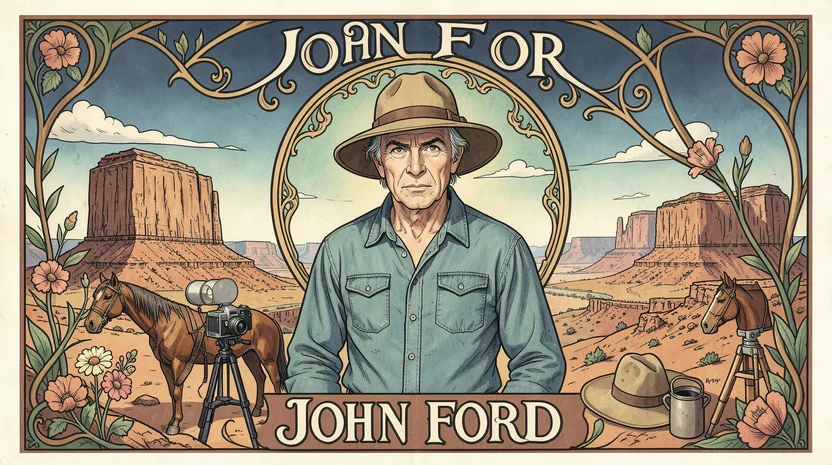
John Ford
About this quiz
This quiz about John Ford features 10 questions. It was generated by one of our users July 6, 2026.
Get ready to saddle up and ride into the cinematic West, because our next quiz is dedicated to a true legend of Hollywood: John Ford. Often hailed as the "poet of the American West," Ford was a visionary director whose films didn't just tell stories; they shaped our very understanding of the American frontier. With a career spanning over five decades and a staggering output of more than 140 films, he carved out a unique and enduring legacy that continues to influence filmmakers and captivate audiences to this day.
Ford's iconic Westerns, with their sweeping vistas, stoic heroes, and morally complex characters, became synonymous with the genre. He had an uncanny ability to capture the grandeur of the landscape while simultaneously delving into the human drama unfolding within it. From the dusty trails of Monument Valley to the rugged individualism of his protagonists, his films are more than just entertainment – they're a powerful exploration of American identity, manifest destiny, and the enduring spirit of the pioneers. So, dust off your knowledge, and let's see if you can conquer this quiz dedicated to the master of the Western.
John Ford: The Master of the American West and Beyond
John Ford is a towering figure in American cinema, a director whose name is synonymous with the Western genre. Yet, to pigeonhole him solely as a Western filmmaker would be a disservice to his vast and impactful career. Ford's films explored the complexities of the American spirit, the challenges of nation-building, the enduring power of community, and the often-harsh realities of life. This study material aims to provide a comprehensive understanding of his life, work, and enduring legacy.
I. Introduction: The Myth and the Man
Who was John Ford?
- Born John Martin Feeney in 1894 in Cape Elizabeth, Maine.
- Irish immigrant parents, instilling a strong sense of heritage and storytelling.
- Came to Hollywood in the silent era, initially as an actor and then as a prolific director for Universal.
- His early career was marked by a remarkable output, often working with limited resources and tight schedules.
The "Fordian" Style: More Than Just Cowboys
- Visual Signature:
- Wide Shots and Landscapes: Ford masterfully used the vast American landscape as a character in itself, often employing wide shots to emphasize the isolation and grandeur of the settings.
- Monument Valley: The iconic red rock formations became a recurring motif, symbolizing the untamed West and the spirit of adventure.
- Composition: Precise framing, often with characters silhouetted against dramatic backdrops or positioned within architectural elements.
- Natural Light: A preference for using natural light to create a sense of realism and atmosphere.
- Thematic Concerns:
- The American West: Exploration of its myths, its harsh realities, and the formation of civilization.
- Individualism vs. Community: The tension between the lone hero and the needs of a collective.
- Law and Order: The establishment and maintenance of justice in frontier settings.
- The Frontier Family: The struggles and resilience of families in building new lives.
- The Soldier and the Cavalry: A recurring fascination with military life, duty, and sacrifice.
- Immigration and Identity: Exploring the experiences of various immigrant groups in America.
- The Passage of Time and Loss: A melancholic undertone often present, reflecting on the fading of the old West and the sacrifices made.
- Character Archetypes:
- The Stoic Hero: Often a man of few words, driven by a strong moral code (e.g., Ethan Edwards, Ringo Kid).
- The Cavalry Officer: Disciplined, dutiful, and often torn between personal feelings and military obligations.
- The "Ford Woman": Strong, independent, and resilient, often providing a moral compass.
- The Outcast/Loner: Figures who operate on the fringes of society but possess a unique integrity.
- Visual Signature:
Ford's Reputation:
- Initially seen as a craftsman, later recognized as a true auteur.
- His films often celebrated a romanticized vision of America, leading some critics to label him as conservative.
- However, a deeper analysis reveals a more complex and nuanced perspective on American ideals and their inherent contradictions.
II. Key Periods and Major Works
Ford's career can be broadly divided into several key periods, each marked by significant thematic developments and stylistic evolutions.
A. The Silent Era (c. 1917-1928)
- Early Successes: Ford quickly established himself as a director capable of delivering entertaining and commercially successful films.
- The Western Foundation: He began honing his skills in the Western genre, directing numerous serials and features.
- Key Films:
- The Iron Horse (1924): A monumental epic about the construction of the Transcontinental Railroad, showcasing Ford's early mastery of scale and historical storytelling. It established the epic Western as a viable genre.
- 3 Bad Men (1926): A more revisionist Western that explored the darker side of frontier justice.
- Four Sons (1928): A poignant drama about an immigrant family during World War I, demonstrating his ability to move beyond the Western.
B. The Transition to Sound and the "Golden Age" of Westerns (c. 1929-1940s)
- Adapting to Sound: Ford embraced the new technology and continued to produce popular films.
- Defining the Classic Western: This era saw the creation of many of his most iconic Westerns, solidifying his reputation.
- Key Films: