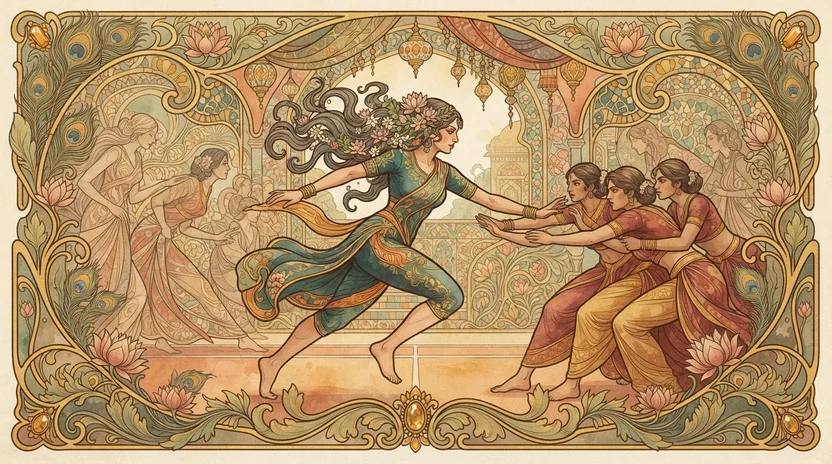
Kabaddi
Similar Quizzes
About this quiz
This quiz about Kabaddi features 10 questions. It was generated by one of our users October 4, 2026.
Kabaddi is a fast team sport built around short, daring raids and coordinated defense. A raider enters the opposing half to tag defenders and return safely, while the other team works together to stop them.
Explore the basics, scoring, tactics, and history in this quiz. Rules can vary between formats, so the guide focuses on widely used standard rules and points out where details may differ.
Kabaddi: Study Guide
Table of Contents
- What Kabaddi Is
- History and Growth
- The Court and Teams
- How a Raid Works
- Defense and Tackling
- Scoring and Revivals
- Skills and Strategy
- Formats and Competitions
- Summary
What Kabaddi Is
Kabaddi is a contact team sport in which players take turns raiding the opposing team’s half of the court. A raider tries to tag one or more defenders and get back across the midline without being tackled. The defenders try to hold the raider until the raid ends. This creates a contest between individual speed and skill on one side, and coordinated teamwork on the other.
A standard indoor team has seven players on court at a time, with additional substitutes available. The game is played in two halves, with a break between them. Match lengths and some details vary by competition and category; a common senior men’s format uses two 20-minute halves. Teams switch sides at halftime.
Kabaddi is known for quick changes in momentum. A single raid can score points, put players out, and change how many defenders the opposing team can field. The sport calls for strength and fitness, but also balance, agility, timing, awareness, and communication.
History and Growth
Kabaddi has deep roots in South Asia, especially in the Indian subcontinent. Forms of the game were played in villages and communities long before modern leagues and international competitions developed. Its precise beginnings are difficult to establish: it grew through regional traditions rather than from one clearly documented inventor or starting date.
Rules were gradually organized into formal versions during the twentieth century, helping the sport move from local play into schools, clubs, and competitions. Kabaddi became a medal sport at the Asian Games in 1990, when the men’s competition was introduced. A women’s competition was added at the 2010 Asian Games. These events helped bring wider international attention to the sport.
Professional leagues have also contributed to kabaddi’s popularity. India’s Pro Kabaddi League began in 2014 and presented matches in a televised, spectator-friendly format. Professional play has helped audiences learn the raid-and-tackle structure, while athletes have gained greater visibility. Kabaddi is now played in many countries, though participation and the rules used can differ from place to place.
The Court and Teams
A standard kabaddi court is rectangular and divided into two equal halves by a midline. Each team defends one half and raids into the other. In commonly used standard dimensions, the men’s court measures 13 metres by 10 metres; dimensions for women’s competitions are often smaller. Exact measurements depend on the governing rules and competition.
Marked lines help determine what a raider must do and where play takes place. The baulk line is a key line in the raiding half: in many standard rules, a raider who has not touched a defender must cross it to make a valid raid. The bonus line is farther into the opponents’ half and can provide a bonus point when the required conditions are met. The lobby runs along the sides of the court and becomes part of active play under specified circumstances, such as contact between players.
Seven players from each side begin on court. Teams also have substitutes, and players who are out may return when their team earns revival points under the applicable rules. The number of defenders left on court matters tactically: a smaller defensive group is more vulnerable to a multi-point raid, but may be able to use a special scoring opportunity when the rules allow it.
How a Raid Works
A raid begins when a player crosses the midline into the opponents’ half. That player is the raider; the opponents on court are defenders. In many modern competitions, a raid must be completed within 30 seconds. The raider must make a legal attempt to score and return to their own half, or the defenders may win the raid by stopping them.
A raider can score by touching defenders and safely returning across the midline. A touch can be made with a hand, foot, or another permitted part of the body, depending on the rules. The raider must avoid stepping out of bounds or being held until the raid ends. If the raider returns safely after tagging opponents, the tagged defenders are out and the raiding team scores for them.
If the raider makes no touch, crossing the baulk line is generally required for the raid to count as a legal attempt. If the raider neither touches an opponent nor satisfies the baulk-line requirement, the raid may be ruled empty or unsuccessful according to the competition rules.
The traditional chant, or cant, is a distinctive part of kabaddi. Raiders traditionally repeat the word kabaddi in a continuous breath while raiding. The cant is part of the sport’s identity, although its enforcement and precise requirements can depend on the format and governing rules. When studying or watching a match, check the competition’s rulebook for the current details.
Defense and Tackling
Defenders work as a unit. They may try to catch a raider by gripping the legs or body, blocking a route back to the midline, or coordinating a tackle with teammates. Common defensive roles include corner and cover positions, named for where players often line up. Good defense depends on patience: defenders need to avoid giving the raider an easy touch while staying close enough to act together.
A tackle is successful when the defense prevents the raider from returning to their own half before the raid ends. The defending team then scores a point, and the raider is out. Tackling requires control and timing as well as strength. Dangerous or illegal contact is not allowed, and officials enforce the rules of the competition to protect players.
The number of defenders remaining can affect the value of a tackle. In widely used rules, when a team has three or fewer defenders on court, a successful tackle may be worth two points; this is called a super tackle. The exact rule should be checked for a particular league or event. Defenders also have to watch for boundary lines: stepping out during active play can give the opposition a point and may put the player out.
A defense can succeed without immediately making a tackle. It can pressure the raider into running out of time, force a poor attempt, or keep a formation that makes escape difficult. The defenders must balance caution with commitment: a mistimed lunge can let the raider touch someone and escape.
Scoring and Revivals
Points in kabaddi come from several actions. A raider who returns safely after touching defenders usually earns one point for each defender put out. If defenders stop the raider, their team earns a point and the raider is out. A bonus point may be available when a raider crosses the bonus line under the required conditions, often when at least six defenders are on court. A bonus point does not necessarily put a defender out.
When a team gets an ordinary scoring point, it can generally bring one previously out player back onto the court. This is called a revival, and teams usually revive players in the order specified by the rules. Bonus points commonly do not trigger a revival. Since rules can vary, the event’s official regulations determine exactly how each score affects the lineup.
If all seven players on a team are put out, the opposing team scores an additional two points for an all-out, also known as a lona. The team that was all out then returns to the court, and play continues. An all-out is valuable because it combines points with the chance to reset the opposing team’s lineup.
These scoring mechanics make the match more than a series of isolated raids. Teams track how many players are out, whether a bonus is available, and how close they are to forcing an all-out. A small lead can change quickly if a team strings together successful raids or makes a coordinated tackle.
Skills and Strategy
Raiders use footwork, balance, speed, and deception to reach defenders and escape. A toe touch or hand touch can score without requiring a long struggle, while a quick change of direction may create an opening. Raiders also judge how many defenders are on court and where they are positioned. A successful raider knows when to attack and when to retreat safely.
Defenders rely on teamwork, communication, and positioning. They may spread out to cover space, stay compact to support a tackle, or tempt a raider toward a particular side. A coordinated chain or hold can cut off the route to the midline. Each defender needs to understand when to close in; if everyone reacts separately, the raider may find a gap.
Substitutions and stamina matter because raids are intense and repeated throughout a match. Coaches choose lineups to balance raiding ability, defensive strength, and fitness. Teams also adjust their risk-taking to the score and time remaining. When ahead late in a match, they may prioritize safe play; when behind, they may accept greater risk to create scoring chances.
Formats and Competitions
Kabaddi is played in several formats. Standard, or indoor mat, kabaddi is widely used in international tournaments and professional leagues. Circle-style kabaddi is another well-known form, with a circular playing area and rules that differ from the standard rectangular game. Other local or recreational versions may use different court sizes, team numbers, and match procedures.
Because formats differ, a rule that applies in one competition may not apply in another. Details such as court dimensions, match length, raid timing, bonus points, and revival procedures can be set by the organizing body. Players, coaches, and viewers should use the official rules for the event rather than assuming that every kabaddi match works exactly the same way.
The Asian Games are a major international stage for the sport, and national and regional competitions also bring teams together. Professional leagues have helped make kabaddi more visible to wider audiences. Across these settings, the game’s central idea remains recognizable: a raider enters enemy territory, while defenders cooperate to stop the escape.
Summary
Kabaddi is a team sport of raids, tags, tackles, and quick decisions. Seven players per team are typically on court, and scoring can put opponents out or bring teammates back through revivals. Court markings and details such as bonus points vary by rule set, so always check the regulations for a specific competition. Its blend of athletic skill and teamwork has helped kabaddi grow from regional traditions into an international sport.