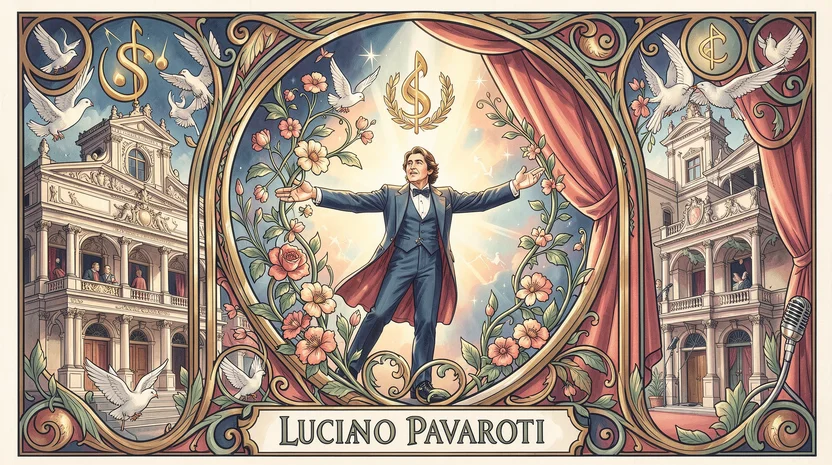
Luciano Pavarotti
Similar Quizzes
About this quiz
This quiz about Luciano Pavarotti features 10 questions. It was generated by one of our users February 20, 2026.
Luciano Pavarotti: The King of High C's
When Luciano Pavarotti stepped onto the stage, magic happened. Born in 1935 in Modena, Italy, this legendary tenor possessed a voice so pure and powerful that it could move audiences to tears and bring entire opera houses to their feet. Pavarotti didn't just sing opera – he transformed it from an elite art form into something accessible to millions around the world. His crystalline high notes, particularly his famous "high C," became his trademark, earning him the nickname "The King of High C's." What made Pavarotti truly special wasn't just his technical brilliance, but his ability to convey raw emotion through his voice, making even non-opera lovers fall under his spell.
Beyond the opera house, Pavarotti became a global superstar who broke down cultural barriers. He joined fellow tenors Plácido Domingo and José Carreras to form "The Three Tenors," whose concerts became worldwide phenomena, including their iconic 1990 performance during the FIFA World Cup. Pavarotti's white handkerchief – which he clutched during performances – became as famous as his voice itself. He collaborated with pop stars like Bono and Elton John, proving that great music transcends genres. When he passed away in 2007, the world didn't just lose an opera singer; it lost a cultural ambassador who had shown that beautiful music could unite people across all backgrounds and borders.
Luciano Pavarotti: The Maestro of the High C
Luciano Pavarotti was a titan of the operatic world, a voice that transcended the concert hall and captured the hearts of millions. His charisma, his unparalleled vocal prowess, and his ability to connect with audiences made him one of the most beloved and recognizable artists of the 20th century. This study material will delve into the life and career of this extraordinary tenor, exploring his origins, his rise to stardom, his most iconic performances, and his enduring legacy.
1. The Voice of a Generation: Vocal Range
Luciano Pavarotti was a world-renowned opera singer, primarily known for his powerful voice in which vocal range?
Pavarotti was a tenor. Specifically, he was celebrated for his lyric-spinto tenor voice. This classification denotes a voice that possesses the warmth and agility of a lyric tenor, capable of executing lighter, more agile passages, but also has the power and dramatic weight (spinto) to carry over a large orchestra in more demanding, dramatic roles. His voice was characterized by its bright timbre, exceptional clarity, effortless high notes (including his famous, ringing high Cs), and remarkable stamina.
2. Roots in the Boot: Birthplace
Which Italian city is Luciano Pavarotti most closely associated with as his birthplace?
Luciano Pavarotti was born in Modena, a city in the Emilia-Romagna region of northern Italy. Modena remained his beloved hometown throughout his life, and he often spoke of his deep connection to its people and culture. The city itself embraced him as a cultural icon, and his presence brought international recognition to Modena.
3. The Three Tenors: Global Phenomenon
Pavarotti gained significant international fame as part of which operatic trio, alongside Plácido Domingo and José Carreras?
Pavarotti achieved immense global fame as part of The Three Tenors. This iconic trio, featuring Luciano Pavarotti, Plácido Domingo, and José Carreras, captivated audiences worldwide with their powerful voices and charismatic stage presence. Their first performance together was at the 1990 FIFA World Cup final, and their subsequent concerts and recordings became bestsellers, introducing opera to a vast new audience.
4. The Triumph of "Nessun Dorma"
What was the name of the famous aria from Giacomo Puccini's opera 'Nessun Dorma' that became one of Pavarotti's signature pieces?
The famous aria is, indeed, "Nessun Dorma" from Giacomo Puccini's opera Turandot. This aria, with its soaring melody and triumphant climax, became synonymous with Pavarotti's voice and a symbol of his ability to convey profound emotion and power. His rendition is widely considered one of the most definitive interpretations of the piece.
5. A Voice for Humanity: Charity Concerts
Besides opera, Pavarotti was also known for his popular concerts and televised performances. What was the name of his annual charity concert series?
Pavarotti's annual charity concert series was called Pavarotti & Friends. Held in his hometown of Modena, these concerts featured Pavarotti performing duets with a dazzling array of international pop, rock, and soul artists, as well as opera colleagues. The concerts raised significant funds for various humanitarian causes, including children's charities and disaster relief efforts, showcasing Pavarotti's commitment to using his fame for good.
6. A Father's Inspiration: Early Career
What early career did Pavarotti pursue before dedicating himself fully to opera, inspired by his father?
Before dedicating himself fully to opera, Luciano Pavarotti was inspired by his father, Fernando Pavarotti, who was also a tenor and sang in the local opera chorus. Initially, Luciano pursued a career as a primary school teacher. He taught for a few years, but the allure of music and his father's encouragement eventually led him to abandon teaching and commit himself entirely to vocal studies and the operatic stage.
7. The Cradle of Italian Opera: Debut
Pavarotti's debut in the opera 'La Bohème' in 1961 was a significant milestone. In which opera house did he perform this debut?
Luciano Pavarotti made his professional opera debut in Giacomo Puccini's La Bohème in Reggio Emilia, Italy. This performance marked the beginning of his illustrious career and set him on the path to becoming one of the most celebrated opera singers of all time.
8. A Conductor's Champion: Collaboration
Which famous conductor, known for his work with the Vienna Philharmonic, was a frequent collaborator and champion of Pavarotti's career?
The famous conductor who was a frequent collaborator and champion of Pavarotti's career was Herbert von Karajan. Karajan, a legendary figure in classical music and a principal conductor of the Vienna Philharmonic, recognized Pavarotti's immense talent early on and played a crucial role in launching and supporting his international career. Their collaborations were highly acclaimed and contributed significantly to Pavarotti's rise.
9. The Soundtrack of a Nation: Sporting Event
Pavarotti's rendition of 'Nessun Dorma' became particularly famous after its use as the theme song for which major sporting event in 1990?
Pavarotti's rendition of "Nessun Dorma" achieved unprecedented global recognition after it was used as the theme song for the 1990 FIFA World Cup, held in Italy. The aria's powerful and emotional crescendo perfectly captured the spirit of the tournament, propelling both the song and Pavarotti to superstardom on an international scale.
10. The Toll of Time: Later Career Challenges
What was one of the primary challenges Pavarotti faced later in his career that led to him scaling back his operatic performances?
One of the primary challenges Pavarotti faced later in his career that led to him scaling back his operatic performances was health issues, specifically related to his vocal cords and later, throat cancer. As he aged, maintaining the rigorous demands of operatic performance became increasingly difficult. His battle with throat cancer, diagnosed in 2006, significantly impacted his ability to sing and ultimately led to his retirement from public performance. This, combined with the physical toll of extensive touring and performance schedules, necessitated a reduction in his operatic engagements.
Conclusion
Luciano Pavarotti was more than just a singer; he was a cultural icon who brought the magic of opera to the masses. His voice, his personality, and his unwavering commitment to his art and to charitable causes left an indelible mark on the world. Studying his life and career offers a fascinating glimpse into the power of music, the dedication required for artistic excellence, and the impact one individual can have on a global scale.