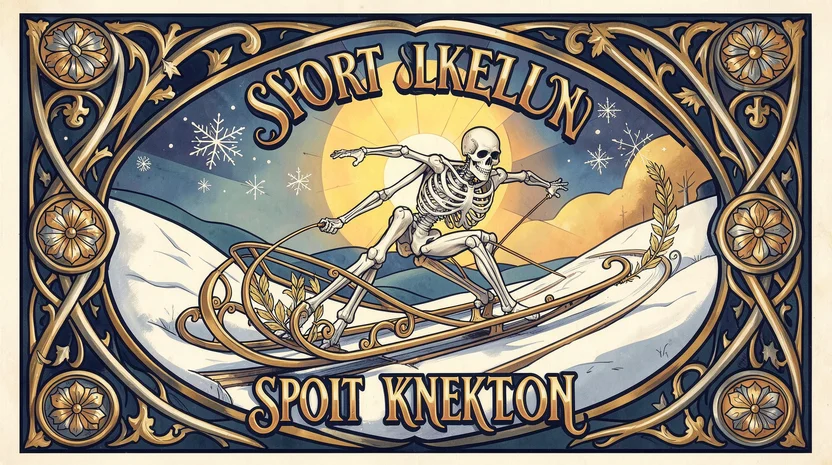
Sport Skeleton
Similar Quizzes
About this quiz
This quiz about Sport Skeleton features 10 questions. It was generated by one of our users February 15, 2026.
The Ultimate Ice Track Thrill Ride
Imagine hurtling down an icy track at speeds reaching 90 mph with nothing but a thin sled between you and disaster – welcome to the death-defying world of skeleton! This spine-tingling winter sport sees fearless athletes sprint alongside their sleds before diving headfirst onto them, racing down a twisting bobsled track with their face mere inches from the ice. Unlike bobsled or luge, skeleton riders lie face-down in a prone position, steering their lightweight carbon-fiber sleds using only subtle body movements and leg pressure while experiencing G-forces that would make fighter pilots sweat.
Born in the late 1800s in the Swiss resort town of St. Moritz, skeleton earned its chilling name from the early sleds' skeletal appearance – just a bare metal frame that resembled human bones. After disappearing from the Olympics for over 50 years, this adrenaline-pumping sport made its triumphant return in 2002, captivating audiences with its unique combination of explosive power, surgical precision, and sheer courage. Modern skeleton athletes are part sprinter, part daredevil, requiring lightning-fast reflexes to navigate tracks featuring up to 20 challenging curves with names like "Kreisel" and "Labyrinth." With races often decided by mere hundredths of a second, skeleton represents the purest form of human versus gravity – where the smallest mistake can mean the difference between Olympic glory and a spectacular crash.
Ready to test your knowledge about this high-speed winter sport? Let's see how much you know about the world's most thrilling ride on ice!
Sport Skeleton: A Complete Guide
Table of Contents
- Introduction
- History and Origins
- Equipment and Gear
- Track and Venue
- Rules and Regulations
- Technique and Skills
- Training and Preparation
- Safety Considerations
- Olympic Competition
- Notable Athletes
- Governing Bodies
- Conclusion
Introduction
Skeleton is a winter sliding sport where athletes race down an ice track while lying face-down on a small sled called a skeleton bobsled. The sport is characterized by its incredible speeds, precise technique, and the athlete's prone position, which gives skeleton its distinctive and thrilling appearance.
Key Characteristics:
- Speed: Athletes can reach speeds of up to 90 mph (145 km/h)
- Position: Riders lie face-down, head-first down the track
- Individual Sport: Unlike bobsled, skeleton is purely individual
- Precision: Success depends on perfect timing, technique, and track knowledge
History and Origins
Early Development
- 1882: The sport originated in St. Moritz, Switzerland
- Name Origin: Called "skeleton" due to the sled's bare-bones appearance
- Evolution: Developed from the earlier sport of "Cresta Run"
Timeline of Major Milestones
| Year | Event |
|---|---|
| 1882 | First skeleton runs in St. Moritz |
| 1892 | First organized competition |
| 1928 | Debut as Olympic sport (men only) |
| 1948 | Second Olympic appearance in St. Moritz |
| 2002 | Return to Olympics in Salt Lake City (men and women) |
| Present | Regular fixture in Winter Olympics |
The Cresta Run Connection
The famous Cresta Run in St. Moritz remains the sport's spiritual home. This natural ice track:
- Is 1,365 meters long
- Features a drop of 157 meters
- Operates from late December to early March
- Hosts the annual world championships
Equipment and Gear
The Skeleton Sled
Specifications:
- Length: Maximum 120cm (men), 114cm (women)
- Width: Maximum 38cm
- Weight: 33-43kg (men), 29-35kg (women)
- Material: Steel frame with steel runners
- Design: Minimal, streamlined for aerodynamics
Key Components:
- Frame: Lightweight steel construction
- Runners: Sharp steel blades for ice contact
- Bumpers: Protective elements at front and rear
- Handles: For pushing and steering
- Padding: Minimal cushioning for the rider
Protective Equipment
Helmet
- Type: Aerodynamic design with chin guard
- Standards: Must meet FIBT safety requirements
- Features: Visor or goggles integration
Racing Suit
- Material: Tight-fitting, aerodynamic fabric
- Purpose: Reduce air resistance
- Regulations: Specific thickness and material requirements
Additional Gear
- Shoes: Specialized with spikes for track grip during start
- Gloves: Lightweight with good grip
- Elbow and Knee Pads: For protection during loading
Track and Venue
Track Design
Specifications:
- Length: 1,200-1,500 meters
- Vertical Drop: 100-150 meters
- Curves: 14-20 banked turns
- Surface: Artificial ice maintained at optimal temperature
Key Features:
- Start House: Where athletes begin their run
- Straightaways: High-speed sections
- Curves: Numbered and named for identification
- Finish Area: Timing and safety zone
Famous Tracks
Olympic Venues:
- Whistler Sliding Centre (Canada) - 2010 Olympics
- Alpensia Sliding Centre (South Korea) - 2018 Olympics
- Yanqing National Sliding Centre (China) - 2022 Olympics
Historic Tracks:
- St. Moritz-Celerina (Switzerland) - Original Olympic track
- Königssee (Germany) - Known for technical difficulty
- Lake Placid (USA) - 1932 and 1980 Olympics venue
Rules and Regulations
Competition Format
Heat Structure:
- Training Runs: 2-5 practice runs
- Official Competition: 4 runs over 2 days
- Timing: Electronic timing to 1/100th of a second
- Ranking: Lowest combined time wins
Starting Procedure
- Push Phase: 50-meter sprint while pushing sled
- Loading: Athlete jumps onto moving sled
- Descent: Navigate track using body positioning
Penalties and Disqualifications
Common Infractions:
- Equipment violations: Non-compliant sled specifications
- False start: Beginning before start signal
- Dangerous driving: Reckless or unsafe technique
- Track infractions: Leaving designated racing line
Technique and Skills
The Start Sequence
Phase 1: The Push (0-50 meters)
1. Explosive start from blocks
2. Maximum acceleration sprint
3. Maintain control of sled
4. Optimal loading position
Phase 2: Loading
1. Jump onto moving sled
2. Assume prone position
3. Grip steering handles
4. Aerodynamic positioning
Steering and Navigation
Steering Techniques:
- Weight Shifting: Primary steering method
- Shoulder Pressure: Fine adjustments
- Leg Positioning: Additional control
- Head Position: Affects aerodynamics
Racing Line Strategy:
- Entry Speed: Optimal velocity into curves
- Apex Selection: Shortest path through turns
- Exit Acceleration: Maximize straightaway speed
Mental Skills
Key Mental Aspects:
- Track Memorization: Know every curve and feature
- Visualization: Mental rehearsal of perfect runs
- Focus: Maintain concentration at high speeds
- Confidence: Trust in technique and equipment
Training and Preparation
Physical Conditioning
Strength Training:
- Power Development: Explosive movements
- Core Stability: Essential for control
- Leg Strength: Critical for push start
- Upper Body: Steering and positioning
Sample Training Week:
Monday: Sprint training + Plyometrics
Tuesday: Weight training (legs/core)
Wednesday: Track practice (if available)
Thursday: Upper body strength + Flexibility
Friday: Sprint intervals
Saturday: Long track session or competition
Sunday: Recovery/light activity
Technical Development
Skill Progression:
- Basic sliding: Learn sled control
- Start technique: Perfect the push phase
- Steering refinement: Advanced line selection
- Race preparation: Competition simulation
Off-Season Training
Summer Activities:
- Track and Field: Sprint and jumping events
- Wheeled Skeleton: Practice on concrete tracks
- Cross Training: Cycling, swimming, running
- Mental Training: Visualization and sports psychology
Safety Considerations
Risk Management
Common Injuries:
- Concussions: From crashes or impacts
- Fractures: Arms, ribs, or legs
- Lacerations: From ice or sled contact
- Hypothermia: Extended cold exposure
Prevention Strategies:
- Proper Equipment: Well-maintained, regulation gear
- Progressive Training: Gradual skill development
- Track Conditions: Optimal ice and weather
- Medical Support: On-site emergency care
Emergency Procedures
Track Safety Features:
- Padding: Strategic placement on dangerous sections
- Barriers: Prevent athletes from leaving track
- Communication: Radio systems for immediate response
- Medical Access: Quick evacuation routes
Olympic Competition
Olympic History
Medal Events:
- Men's Skeleton: Since 2002 (previously 1928, 1948)
- Women's Skeleton: Since 2002
Competition Structure
Olympic Format:
- Training: Multiple practice sessions
- Competition: 4 official runs
- Schedule: Typically over 2-3 days
- Participants: Approximately 20-30 athletes per gender
Qualification Process
Path to Olympics:
- National Championships: Domestic competition
- World Cup Circuit: International ranking events
- World Championships: Annual global competition
- Olympic Qualification: Based on world rankings
Notable Athletes
Legendary Competitors
Men's Champions:
- Duff Gibson (Canada): 2006 Olympic Champion
- Alexander Tretiakov (Russia): 2014 Olympic Champion
- Yun Sung-bin (South Korea): 2018 Olympic Champion
Women's Champions:
- Tristan Gale (USA): 2002 Olympic Champion
- Shelley Rudman (Great Britain): 2006 Olympic Silver
- Amy Williams (Great Britain): 2010 Olympic Champion
- Lizzy Yarnold (Great Britain): 2014, 2018 Olympic Champion
Record Holders
Speed Records:
- Men's Track Record: Various tracks, speeds up to 90+ mph
- Women's Track Record: Slightly lower due to different start positions
Governing Bodies
International Federation
IBSF (International Bobsleigh and Skeleton Federation):
- Founded: 1923
- Headquarters: Lausanne, Switzerland
- Responsibilities:
- Rule development and enforcement
- Competition sanctioning
- Safety standards
- Drug testing and anti-doping
National Organizations
Major National Bodies:
- USA Bobsled & Skeleton: United States
- Bobsleigh Canada Skeleton: Canada
- British Bobsleigh & Skeleton Association: United Kingdom
- Bob- und Schlittenverband Deutschland: Germany
Conclusion
Skeleton represents one of the purest and most thrilling winter sports, combining raw speed, technical precision, and incredible courage. From its humble beginnings on the natural ice tracks of Switzerland to its current status as an Olympic sport, skeleton continues to captivate athletes and spectators alike.
Key Takeaways:
- Accessibility: While specialized, skeleton can be learned by dedicated athletes
- Safety: Modern safety measures have significantly reduced risks
- Competition: Multiple levels from local to Olympic competition
- Global Growth: Expanding worldwide with new tracks and programs
Getting Started:
For those interested in trying skeleton:
- Contact your national federation
- Attend a "try skeleton" event
- Visit a local sliding track
- Connect with experienced coaches and athletes
The sport of skeleton offers an unparalleled combination of speed, skill, and excitement that few other sports can match. Whether as a participant or spectator, skeleton provides an unforgettable experience that showcases human courage and athletic excellence at its finest.
Remember: Skeleton is an extreme sport that requires proper training, equipment, and supervision. Always prioritize safety and work with qualified instructors when learning the sport.