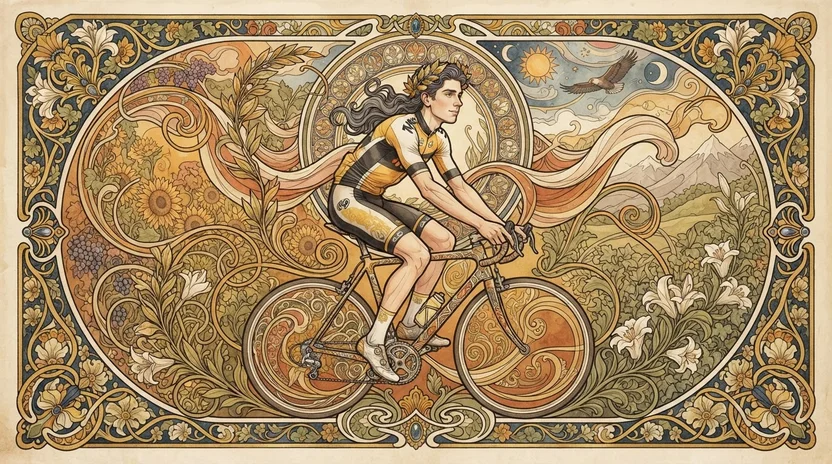
Tadej Pogacar
Similar Quizzes
About this quiz
This quiz about Tadej Pogacar features 10 questions. It was generated by one of our users October 4, 2026.
Tadej Pogačar is a Slovenian professional cyclist known for his versatility, attacking style, and success in the sport’s biggest races. He has won the Tour de France multiple times and claimed major victories in both stage races and one-day classics.
How much do you know about his career, his racing strengths, and the achievements that have made him one of cycling’s leading riders? Take the quiz to find out.
Tadej Pogacar: Study Guide
Table of Contents
- Who he is
- Early career and breakthrough
- The Tour de France
- A versatile Grand Tour rider
- One-day races and major victories
- Riding style and racing roles
- Teams, jerseys, and terminology
- How to understand his achievements
- Summary
Who he is
Tadej Pogačar is a Slovenian professional road cyclist. His surname is often written without its caron accent as Pogacar, particularly in English-language settings. He was born on 21 September 1998 in Komenda, Slovenia. Pogačar races for UAE Team Emirates, the team he joined as a professional in 2019.
Road cycling includes several kinds of competition. Stage races last multiple days and combine the results of individual stages into an overall classification. One-day races are decided by a single day’s racing. Pogačar is notable because he has excelled in both formats: he has won Grand Tours, which are the sport’s three-week stage races, as well as some of cycling’s most prestigious one-day events.
His most famous achievement is winning the Tour de France, the best-known Grand Tour, in 2020, 2021, and 2024. He has also won the Giro d’Italia, another Grand Tour, and claimed the world road race championship. These victories have established him as a rider capable of competing for overall wins, stage victories, and major classics.
Early career and breakthrough
Pogačar became a professional with UAE Team Emirates in 2019. That year, he rode the Vuelta a España, his first Grand Tour. He finished third overall and won three stages. This was a remarkable result for a rider making his Grand Tour debut, and it quickly drew attention to his potential as a future contender in the biggest stage races.
His first Tour de France came in 2020. Pogačar entered as a young rider, but by the final stages he was challenging for the overall title. On stage 20, an individual time trial ending at La Planche des Belles Filles, he produced a striking ride and took the yellow jersey from fellow Slovenian Primož Roglič. Pogačar went on to win the Tour overall and the young rider classification. He also won the mountains classification, whose winner wears the polka-dot jersey.
At 21 years old when that Tour began, Pogačar became the youngest winner of the race in the modern era. His comeback in the final time trial became one of the defining moments of the 2020 Tour. Rather than merely defend a lead, he had to gain enough time on Roglič to change the overall standings—and succeeded.
The Tour de France
Pogačar defended his Tour de France title in 2021, winning the overall classification again. He has won the race three times: in 2020, 2021, and 2024. He finished second overall in both 2022 and 2023, making the Tour a sustained contest among the leading riders rather than a single-season success.
The Tour’s overall winner is determined by cumulative time. Each rider’s times from the stages are added together, with time bonuses and penalties applied according to the rules. The rider with the lowest total time wins the general classification and wears the yellow jersey. A stage winner, by contrast, wins one day’s race; winning a stage does not by itself mean winning the Tour.
Pogačar has repeatedly combined overall ambition with stage wins. In 2024, he won six stages as well as the overall title. His Tour success reflects skill in mountain stages, where steep climbs can create large time gaps, and in time trials, where riders race individually against the clock. A Grand Tour contender also needs consistency across three demanding weeks, including on days when the course does not suit their strongest abilities.
Pogačar has also won the Tour’s young rider classification several times. That classification compares eligible younger riders in the general classification; its leader wears a white jersey. It is separate from the yellow jersey for the overall leader and from the polka-dot jersey for the mountains classification.
A versatile Grand Tour rider
The Giro d’Italia and the Vuelta a España, alongside the Tour de France, make up cycling’s three Grand Tours. Each lasts around three weeks and has its own history, route, and character. Winning one is a major career achievement; winning more than one demonstrates success across different races and conditions.
In 2024, Pogačar won the Giro d’Italia overall and took six stages. Later that year, he won the Tour de France overall and took another six stages. By winning both in one season, he became the first rider since Marco Pantani in 1998 to achieve the Giro–Tour double. Completing this double is especially difficult because both races are long, physically demanding events held close together in the racing calendar.
Pogačar’s first Grand Tour podium came at the 2019 Vuelta, where he finished third and won three stages. That result, the 2020 Tour victory, and the 2024 Giro–Tour double illustrate different points in his development: a rapid breakthrough, a historic first Tour title, and later success across two Grand Tours in the same year.
Stage races reward both daily performance and recovery. A rider aiming for the overall win must limit time losses throughout the race, while choosing when to attack or conserve energy. Team support matters too: teammates can help with pacing, positioning, and controlling the race, but the final result depends on each rider’s own performance.
One-day races and major victories
Pogačar’s ability is not limited to three-week races. He has won major one-day events known as cycling monuments. These races are among the most prestigious classics on the calendar and often feature long distances, challenging terrain, and intense competition.
He won Liège–Bastogne–Liège in 2021 and 2024. The Belgian race is a hilly classic, with repeated climbs that can reward a powerful climber who can also sustain a long effort. In 2023, Pogačar won the Tour of Flanders, another monument, renowned for its cobbled roads and short, steep climbs. Winning Flanders requires careful positioning as well as strength, since narrow roads and cobbles can make it difficult to move through the group.
Pogačar has also won Il Lombardia, often called the Race of the Falling Leaves. He won it four years in a row, from 2021 through 2024. This hilly Italian monument is a late-season race, and its demanding climbs suit riders who can make decisive efforts late in a long day.
In 2024, Pogačar won the UCI Road World Championships men’s road race in Zürich, Switzerland. A world champion wears the rainbow jersey in road races during the following year. This is distinct from the yellow jersey of the Tour de France: rainbow stripes identify the reigning world road race champion, not the leader of a particular stage race.
Riding style and racing roles
Pogačar is often described as an all-rounder because he can perform well in several types of road race. He has shown strength on climbs, in stage-race time trials, and in long one-day races. His results do not mean he is equally suited to every course; rather, his range lets him compete for different goals across the calendar.
A climber seeks to perform strongly on steep or extended ascents, where riders can gain or lose significant time. A time-trial specialist is particularly effective in individual races against the clock. A classics rider targets demanding one-day events. Pogačar’s record includes achievements associated with all these roles, which helps explain why he is considered unusually versatile.
Attacking is an important part of his public racing reputation. A rider may attack by accelerating away from the group, either to win a stage, gain time in the general classification, or force rivals to respond. Attacks can be costly: if they fail, the rider may spend energy without gaining an advantage. Successful racing requires judging the course, the rivals, the remaining distance, and how much effort can be sustained.
Cycling remains a team sport even when one rider is the headline contender. Teammates may protect a leader from wind, help keep them near the front, set a pace on climbs, or pursue a breakaway. The leader, in turn, may be responsible for delivering the result. Understanding this teamwork makes it easier to interpret why a rider’s performance is shaped by more than individual strength alone.
Teams, jerseys, and terminology
Pogačar has ridden for UAE Team Emirates since turning professional in 2019. A professional team plans its season, selects riders for races, and assigns goals. For a Grand Tour, a team may bring a designated leader and teammates whose roles include supporting that leader on climbs, flat roads, or in time trials.
Several distinctive jerseys help viewers follow stage races. In the Tour de France, yellow identifies the general classification leader, white identifies the leading eligible young rider, and polka dots identify the mountains classification leader. The precise rules for classifications can vary by race, so the jersey’s meaning should be tied to the event being watched.
The rainbow jersey is different: it belongs to the reigning world champion in the relevant cycling discipline. Pogačar earned the men’s road race rainbow jersey by winning the 2024 UCI Road World Championships. A stage winner earns a victory for that stage, while the general classification is based on cumulative time across the whole race. These terms describe different accomplishments and should not be treated as interchangeable.
A monument is one of the five historic, highly prestigious one-day races in road cycling. The Tour of Flanders, Liège–Bastogne–Liège, and Il Lombardia are three of them. The three Grand Tours, in contrast, are multi-week stage races. Pogačar’s wins in both categories show the breadth of his career.
How to understand his achievements
Pogačar’s career can be understood through the variety and scale of his victories. His 2019 Vuelta podium marked an early breakthrough. His Tour de France wins in 2020 and 2021 established him as a leading stage racer. The Giro–Tour double in 2024 showed that he could win two Grand Tours in one season, while his monument victories and world title demonstrated success beyond stage racing.
When comparing results, distinguish the race, the classification, and the year. For example, saying Pogačar won the 2024 Tour overall is different from saying he won six stages at that Tour. Both are true, but they refer to separate achievements. Similarly, a victory at a one-day classic is not a Grand Tour title, even if both are major road-racing wins.
It is also useful to remember that race outcomes are competitive and change each year. A rider can win a race one season and finish second another. Pogačar’s second-place Tour finishes in 2022 and 2023 do not diminish his overall wins; they show how closely contested the race can be. Studying the dates and types of victories helps create a more accurate picture than relying on a single headline result.
Summary
Tadej Pogačar is a Slovenian cyclist who has won the Tour de France three times, claimed the 2024 Giro–Tour double, and achieved major victories in one-day classics and the world road race championship. His success across different race formats makes versatility a key theme of his career.