Three Mile Island Accident
Similar Quizzes
About this quiz
This quiz about Three Mile Island Accident features 10 questions. It was generated by one of our users February 23, 2026.
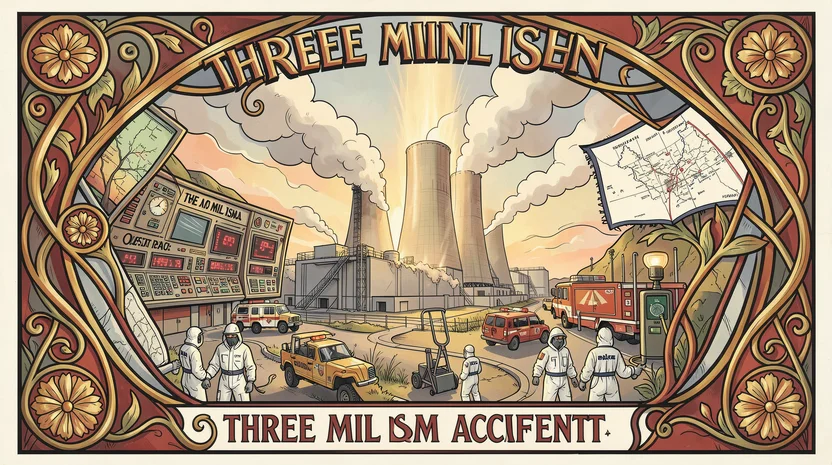
On a chilly March morning in 1979, the tranquil routine at the Three Mile Island nuclear power plant in Pennsylvania was shattered, marking a pivotal moment in both nuclear energy and public perception. What began as a seemingly minor mechanical malfunction – a jammed valve – spiraled into a complex and terrifying accident that would unfold over several days. The incident at Unit 2 brought the nation, and indeed the world, to the edge of their seats as fears of a nuclear meltdown and widespread contamination loomed large.
The Three Mile Island accident wasn't just a technical failure; it was a profound lesson in safety protocols, emergency response, and the delicate balance between technological advancement and public trust. For those seeking to understand the history and implications of nuclear power, this event serves as a crucial case study. Prepare to delve into the sequence of events, the critical decisions made, and the lasting impact of this near-catastrophe that forever changed the landscape of nuclear energy.
The Three Mile Island Accident: A Comprehensive Study Guide
The Three Mile Island (TMI) accident, which occurred on March 28, 1979, remains one of the most significant events in the history of nuclear power. It was a complex series of failures that led to a partial meltdown of the reactor core, causing widespread public concern and profoundly impacting the future of nuclear energy regulation and public perception. This study guide will delve into the causes, events, consequences, and lessons learned from this pivotal incident.
1. Introduction to Three Mile Island
- Location: Dauphin County, Pennsylvania, USA.
- Facility: Three Mile Island Nuclear Generating Station, Unit 2 (TMI-2).
- Type of Reactor: Pressurized Water Reactor (PWR).
- Date of Accident: March 28, 1979.
- Significance: The most serious accident in U.S. commercial nuclear power plant history, leading to a partial meltdown and significant public fear.
2. The Anatomy of a Pressurized Water Reactor (PWR)
To understand the TMI accident, it's crucial to grasp the basic principles of a PWR:
- Primary Coolant Loop: Water under high pressure circulates through the reactor core, absorbing heat generated by nuclear fission. This hot, high-pressure water then flows to a steam generator.
- Steam Generator: Heat from the primary loop water is transferred to a secondary loop of water, turning it into steam. The primary loop water remains contained and does not come into direct contact with the secondary loop.
- Secondary Coolant Loop: The steam generated in the steam generator drives a turbine, which in turn powers an electric generator to produce electricity. After passing through the turbine, the steam is condensed back into water in a condenser and pumped back to the steam generator.
- Containment Building: The reactor and primary coolant system are housed within a robust, reinforced concrete containment building designed to prevent the release of radioactive materials in case of an accident.
Diagrammatic Representation (Simplified):
       +-----------------+
       | Reactor Core    |
       | (Fission)       |
       +-------+---------+
               | (Hot Water)
               v
       +-----------------+
       | Steam Generator | <-------+ (Water)
       +-------+---------+         |
               | (Steam)           | (Cool Water)
               v                   |
       +-----------------+         |
       | Turbine         |---------+ (Condenser)
       +-------+---------+
               | (Electricity)
               v
       +-----------------+
       | Generator       |
       +-----------------+
3. The Chain of Events: A Cascade of Failures
The TMI accident was not a single, catastrophic event but rather a series of interconnected failures and human errors that escalated the situation.
3.1. The Initial Trigger: A Clogged Filter and a Pump Failure
- March 28, 1979, 4:00 AM: A clogged filter in the secondary cooling system caused a feedwater pump to shut down.
- Consequences: This stopped the flow of water to the steam generator, preventing the removal of heat from the primary coolant loop.
3.2. The Automatic Response and an Unforeseen Problem
- Automatic Safety Systems: The plant's automatic safety systems responded to the loss of feedwater by initiating a pilot-operated relief valve (PORV) in the primary coolant system. This valve is designed to open automatically if pressure in the primary loop exceeds a certain limit, releasing excess steam.
- The Critical Error: Crucially, the PORV failed to close after the pressure dropped back to normal levels. This was compounded by the fact that the indicator light for the valve's position was misleading, suggesting it was closed when it was, in fact, open.
3.3. The Loss of Coolant and the Growing Danger
- Uncontrolled Steam Release: With the PORV stuck open, hot, high-pressure water and steam continuously escaped from the primary coolant system, leading to a gradual but significant loss of coolant.
- Operator Misinterpretation: The control room operators were unaware that the PORV was open. They observed the rising temperature and pressure, but the misleading indicator lights and the lack of clear information led them to believe the problem was elsewhere.
- Human Intervention and Misguided Actions: In an attempt to manage the perceived high pressure, operators took actions that inadvertently exacerbated the situation:
- They closed the main feedwater valves to the steam generator, further reducing the ability to cool the primary system.
- They activated emergency core cooling systems (ECCS), but then manually shut them down because they believed the primary system was already overfilled with water (due to the steam release, which they misinterpreted as water). This was a critical mistake.
3.4. The Partial Meltdown
- Insufficient Cooling: Without adequate cooling, the temperature and pressure in the reactor core began to rise again.
- Fuel Rod Damage: The water level in the reactor vessel dropped below the top of the fuel rods. The exposed fuel rods overheated, leading to the rupture of their cladding and the release of radioactive fission products into the primary coolant.
- Core Damage: This overheating and cladding failure marked the beginning of a partial meltdown of the reactor core. A significant portion of the uranium fuel pellets melted and slumped to the bottom of the reactor vessel.
3.5. The Release of Radioactivity
- Containment Integrity: While the containment building remained largely intact, the continuous release of steam and radioactive gases from the open PORV and subsequent system breaches meant that some radioactive materials escaped into the atmosphere.
- Gaseous Release: Primarily, noble gases (like Xenon and Krypton) were released, which have short half-lives and are generally less harmful than solid radioactive isotopes. However, there were also small releases of other radioactive isotopes.
4. Consequences and Impacts
The Three Mile Island accident had far-reaching consequences, impacting public health, the environment, the nuclear industry, and regulatory practices.
4.1. Public Health and Environmental Impact
- No Direct Fatalities: Fortunately, there were no immediate deaths or injuries directly attributable to radiation exposure from the accident.
- Long-Term Health Concerns: While the released radiation levels were not acutely dangerous, there were concerns about potential long-term health effects, such as increased cancer rates, among the exposed population. However, definitive links have been difficult to establish due to the low doses and complex factors involved.
- Psychological Impact: The accident caused significant fear and anxiety among residents in the surrounding areas, leading to mass evacuations and lasting psychological distress.
- Environmental Contamination: Radioactive materials were released into the environment, primarily through ventilation systems and the open PORV. Decontamination efforts were extensive and costly.
4.2. Economic and Industrial Impact
- Costly Decommissioning: The TMI-2 reactor was permanently shut down and the process of decontaminating and decommissioning the site was incredibly complex and expensive, taking decades and costing billions of dollars.
- Industry Stagnation: The accident severely damaged public trust in nuclear power. It led to a significant slowdown in the construction of new nuclear power plants in the United States and a period of intense scrutiny and regulatory reform for the existing fleet.
- Increased Insurance Costs: The nuclear industry faced higher insurance premiums and increased liability concerns.
4.3. Regulatory and Political Impact
- The Kemeny Commission: The U.S. government established the Presidential Commission on the Accident at Three Mile Island (the Kemeny Commission) to investigate the accident.
- Key Findings of the Kemeny Commission:
- The accident was a result of a combination of design deficiencies, human error, and institutional weaknesses.
- There was a serious lack of understanding of nuclear reactor safety principles among some operators and managers.
- The regulatory framework was inadequate and lacked sufficient oversight.
- Communication with the public was poor and often misleading.
- Creation of the NRC's Office of Nuclear Reactor Regulation: The accident led to significant reforms within the U.S. Nuclear Regulatory Commission (NRC). The NRC was restructured, and a new office was established to focus on reactor regulation and safety oversight.
- Enhanced Safety Standards: New safety regulations were implemented, including more rigorous training for operators, improved emergency preparedness plans, and enhanced monitoring of plant operations.
- Shift in Public Perception: The accident dramatically shifted public opinion against nuclear power, contributing to a decline in its growth and expansion for many years.
5. Lessons Learned and Legacy
The Three Mile Island accident serves as a crucial case study in risk management, technological safety, and the importance of human factors.
5.1. Importance of Human Factors and Training
- Beyond Mechanical Failures: TMI highlighted that even with advanced technology, human error and inadequate training can have catastrophic consequences.
- Operator Training and Simulation: The accident led to a revolution in operator training, emphasizing the use of realistic simulators to practice emergency procedures and decision-making under pressure.
- Clearer Instrumentation and Control Room Design: The misleading indicator lights at TMI underscored the need for unambiguous instrumentation and well-designed control rooms that provide operators with accurate and easily interpretable information.
5.2. Robust Emergency Preparedness and Public Communication
- Evacuation Planning: The accident exposed weaknesses in emergency response planning and public communication. This led to the development of comprehensive evacuation plans for communities surrounding nuclear power plants.
- Transparent Communication: The need for clear, honest, and timely communication with the public during emergencies became paramount.
5.3. Safety Culture and Regulatory Oversight
- "Safety First" Culture: The accident emphasized the need for a strong "safety first" culture within the nuclear industry, where safety is prioritized above all else, including production.
- Independent Regulatory Oversight: The Kemeny Commission's findings reinforced the critical role of an independent and effective regulatory body (like the NRC) to ensure the safety of nuclear facilities.
5.4. Defense-in-Depth Philosophy
- Layered Safety: The accident reinforced the importance of the "defense-in-depth" philosophy, which involves multiple independent layers of safety systems and procedures to prevent accidents and mitigate their consequences.
5.5. The Future of Nuclear Power
- Increased Scrutiny and Caution: While the accident didn't end nuclear power, it ushered in an era of increased scrutiny, caution, and a more demanding regulatory environment.
- Renewed Interest: In recent years, with growing concerns about climate change and the need for low-carbon energy sources, there has been a renewed interest in nuclear power. However, the lessons learned from TMI and other accidents continue to inform the design and operation of new nuclear facilities.
6. Key Terms and Concepts
- Pressurized Water Reactor (PWR): A type of nuclear reactor.
- Primary Coolant Loop: The system circulating water through the reactor core.
- Steam Generator: Where heat is transferred to create steam.
- Pilot-Operated Relief Valve (PORV): A safety valve that can open automatically.
- Loss of Coolant Accident (LOCA): An accident where coolant leaks from the primary system.
- Emergency Core Cooling System (ECCS): Safety systems designed to cool the reactor core during emergencies.
- Partial Meltdown: When a portion of the reactor core overheats and melts.
- Fission Products: Radioactive substances produced during nuclear fission.
- Containment Building: A structure designed to prevent the release of radioactivity.
- Kemeny Commission: The U.S. presidential commission that investigated the TMI accident.
- Defense-in-Depth: A safety philosophy involving multiple layers of protection.
- Safety Culture: The organizational commitment to safety.
7. Study Questions
- Describe the basic operation of a Pressurized Water Reactor (PWR).
- What was the initial trigger for the Three Mile Island accident?
- Explain the critical failure of the Pilot-Operated Relief Valve (PORV) and its consequences.
- How did operator actions contribute to the escalation of the accident?
- What is a "partial meltdown," and how did it occur at TMI?
- What were the primary consequences of the TMI accident for public health and the environment?
- How did the TMI accident impact the U.S. nuclear industry and regulatory practices?
- What were the main findings of the Kemeny Commission?
- Discuss the key lessons learned from the Three Mile Island accident regarding human factors, emergency preparedness, and safety culture.
- How has the TMI accident influenced the perception and development of nuclear power?
This comprehensive study material provides a foundation for understanding the Three Mile Island accident. Remember to consult additional resources and scholarly articles for a deeper and more nuanced understanding of this complex and historically significant event.