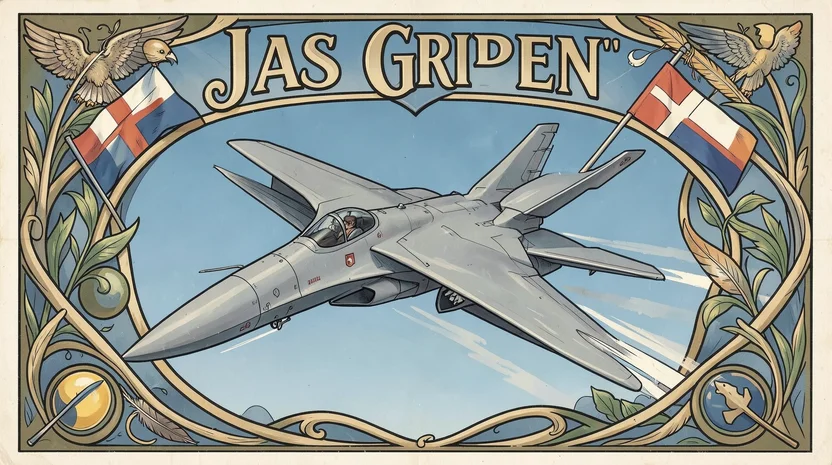
Jas Gripen
Similar Quizzes
About this quiz
This quiz about Jas Gripen features 10 questions. It was generated by one of our users February 12, 2026.
The JAS 39 Gripen: Sweden's Flying Viking
In the world of modern fighter aircraft, few jets embody the philosophy of "small but mighty" quite like Sweden's JAS 39 Gripen. This sleek, delta-winged marvel represents the pinnacle of Scandinavian engineering ingenuity, designed to defend Sweden's vast territory and long coastline against potential threats during the Cold War era. The name "Gripen" – meaning "Griffin" in Swedish – perfectly captures this aircraft's mythical blend of power and agility, much like the legendary creature that combines the strength of a lion with the grace of an eagle.
What makes the Gripen truly remarkable isn't just its impressive performance capabilities, but its revolutionary design philosophy. Swedish engineers created a multirole fighter that can take off and land on ordinary roads, be maintained by a small crew of technicians, and switch between air-to-air combat, ground attack, and reconnaissance missions with remarkable ease. The "JAS" designation itself tells the story – standing for "Jakt" (fighter), "Attack" (ground attack), and "Spaning" (reconnaissance) – highlighting its versatility as a true Swiss Army knife of the skies. From its first flight in 1988 to its current service with air forces around the globe, the Gripen has proven that innovation often trumps size, earning respect from pilots and aviation enthusiasts worldwide for its advanced avionics, fuel efficiency, and surprisingly affordable operating costs.
JAS 39 Gripen: The Swedish Air Superiority Fighter
Table of Contents
- Introduction
- Development History
- Design Philosophy
- Technical Specifications
- Variants
- Operational Capabilities
- International Success
- Comparison with Contemporary Fighters
- Future Developments
- Conclusion
Introduction
The JAS 39 Gripen (Griffin) is Sweden's premier multi-role fighter aircraft, representing one of the most successful examples of modern aerospace engineering from a smaller nation. The acronym "JAS" stands for:
- J - Jakt (Fighter/Air-to-air)
- A - Attack (Ground attack)
- S - Spaning (Reconnaissance)
This designation reflects the aircraft's multi-role capabilities, designed to replace multiple aircraft types in the Swedish Air Force with a single, versatile platform.
💡 Did You Know? The Gripen was designed with Sweden's unique defense doctrine in mind, requiring the ability to operate from short, improvised airstrips during wartime.
Development History
Origins and Requirements (1980s)
The Gripen program began in the early 1980s when Sweden identified the need to replace its aging fleet of:
- Saab 35 Draken (interceptor)
- Saab 37 Viggen (multi-role fighter)
- Saab SK 60 (trainer/light attack)
Key Development Milestones
| Year | Milestone |
|---|---|
| 1982 | Swedish government approves development |
| 1988 | First prototype flight (December 9) |
| 1989 | First prototype crash (February 2) |
| 1993 | Crash of second prototype |
| 1996 | First delivery to Swedish Air Force |
| 1997 | Initial operational capability |
Design Challenges
The development faced several significant challenges:
- Flight Control Issues: Early prototypes suffered from unstable flight characteristics
- Software Problems: Complex fly-by-wire system required extensive debugging
- Political Pressure: Crashes led to political scrutiny and program reviews
- Budget Constraints: Cost overruns threatened program continuation
Industrial Collaboration
The Gripen represents a successful international collaboration:
- Saab (Sweden) - Prime contractor and final assembly
- BAE Systems (UK) - Avionics and systems integration
- Volvo Aero (Sweden) - Engine modifications and maintenance
Design Philosophy
Core Principles
The Gripen was designed around several key principles that distinguish it from other fighter aircraft:
1. **Cost-Effectiveness**
- Lower acquisition cost compared to competitors
- Reduced operational and maintenance costs
- Simplified logistics chain
2. **Operational Flexibility**
- Ability to operate from 800-meter runways
- Quick turnaround times (10 minutes for refuel and rearm)
- Minimal ground support equipment requirements
3. **Network-Centric Warfare**
- Advanced data-link capabilities
- Information sharing with ground forces and other aircraft
- Sensor fusion technology
4. **Pilot-Friendly Design**
- Intuitive cockpit layout
- Reduced pilot workload
- Excellent situational awareness
Swedish Defense Doctrine Integration
The aircraft was specifically designed to support Sweden's "Base 90" defense concept:
Base 90 Concept:
├── Dispersed Operations
│   ├── Highway strips as airbases
│   ├── Minimal ground crew (6 personnel)
│   └── Rapid deployment capability
├── Survivability
│   ├── Low radar signature
│   ├── Electronic countermeasures
│   └── Redundant systems
└── Multi-role Capability
    ├── Air-to-air combat
    ├── Ground attack missions
    └── Reconnaissance operations
Technical Specifications
JAS 39C/D Gripen
Physical Dimensions
- Length: 14.1 m (46.3 ft)
- Wingspan: 8.4 m (27.6 ft)
- Height: 4.5 m (14.8 ft)
- Wing Area: 30 m² (323 ft²)
Performance
- Maximum Speed: Mach 2.0 (2,470 km/h at altitude)
- Service Ceiling: 15,240 m (50,000 ft)
- Range: 3,200 km (1,988 mi) with external tanks
- G-Limits: +9/-3 g
Weights
- Empty Weight: 6,800 kg (14,991 lb)
- Max Takeoff Weight: 14,000 kg (30,865 lb)
- Fuel Capacity: 3,100 kg internal
Powerplant
- Engine: Volvo RM12 (modified GE F404)
- Thrust: 54 kN dry, 80.5 kN with afterburner
- Fuel Consumption: Optimized for efficiency
Avionics and Systems
Radar Systems
- PS-05/A: X-band pulse-Doppler radar
- Range: 120+ km for fighter-sized targets
- Modes: Air-to-air, air-to-ground, weather
Electronic Warfare
- RWR: 360-degree threat warning
- ECM: Integrated countermeasures
- Chaff/Flare: Automatic dispensing system
Navigation
- GPS/INS: Dual navigation systems
- TACAN: Tactical air navigation
- ILS: Instrument landing capability
Variants
JAS 39A (Single-seat, early production)
- First Flight: 1988
- Production: 1996-2013
- Operators: Sweden
- Features: Basic multi-role capability
JAS 39B (Two-seat trainer)
- First Flight: 1996
- Production: 1996-2013
- Operators: Sweden
- Features: Dual controls, reduced fuel capacity
JAS 39C (Single-seat, improved)
- First Flight: 2002
- Production: 2003-2018
- Operators: Sweden, Czech Republic, Hungary, South Africa, Thailand
- Improvements:
- Enhanced avionics
- NATO compatibility
- Air-to-air refueling capability
- Improved radar
JAS 39D (Two-seat, improved)
- First Flight: 2005
- Production: 2005-2018
- Operators: Sweden, South Africa, Thailand
- Features: Two-seat version of 39C
JAS 39E/F Gripen (Next Generation)
- First Flight: 2017
- Status: In production
- Operators: Sweden, Brazil
- Major Improvements:
- Larger airframe
- More powerful engine (GE F414)
- AESA radar
- Enhanced electronic warfare systems
- Supercruise capability
Operational Capabilities
Air-to-Air Combat
The Gripen excels in air superiority missions with:
Weapons Systems
- AIM-120 AMRAAM: Beyond visual range missiles
- AIM-9 Sidewinder: Short-range heat-seeking missiles
- IRIS-T: European short-range missile
- Meteor: Next-generation long-range missile (Gripen E)
Tactical Advantages
- Small Radar Cross Section: Difficult to detect
- Excellent Maneuverability: Delta-canard configuration
- Superior Situational Awareness: Data-link integration
- Quick Reaction Time: Rapid scramble capability
Air-to-Ground Operations
Ground attack capabilities include:
Precision Weapons
- GBU-12 Paveway II: Laser-guided bombs
- GBU-49: Enhanced Paveway II
- AGM-65 Maverick: Air-to-surface missiles
- Taurus KEPD 350: Long-range cruise missiles
Mission Types
- Close Air Support: Direct support to ground forces
- Interdiction: Deep strike missions
- SEAD/DEAD: Suppression/Destruction of enemy air defenses
- Maritime Strike: Anti-ship operations
Reconnaissance
Intelligence gathering through:
- Electro-optical pods: Day/night imaging
- SAR pods: Synthetic aperture radar
- ELINT systems: Electronic intelligence gathering
- Real-time data transmission: Immediate intelligence sharing
International Success
Export Customers
The Gripen has achieved notable international success:
🇨🇿 Czech Republic
- Aircraft: 12 JAS 39C, 2 JAS 39D
- Contract: Lease agreement (2004-2027)
- Role: Air policing, NATO missions
🇭🇺 Hungary
- Aircraft: 12 JAS 39C, 2 JAS 39D
- Contract: Lease agreement (2001-2026)
- Role: Air sovereignty, NATO integration
🇿🇦 South Africa
- Aircraft: 17 JAS 39C, 9 JAS 39D
- Contract: Purchase (1999)
- Role: Air defense, regional security
🇹🇭 Thailand
- Aircraft: 6 JAS 39C, 6 JAS 39D
- Contract: Purchase (2008, 2010)
- Role: Air defense, maritime patrol
🇧🇷 Brazil
- Aircraft: 28 JAS 39E, 8 JAS 39F (on order)
- Contract: F-X2 program winner (2013)
- Features: Technology transfer, local production
Competitive Advantages
The Gripen's export success stems from:
- Life-Cycle Cost: Significantly lower than competitors
- Technology Transfer: Willingness to share technology
- Flexible Financing: Lease and purchase options
- Political Neutrality: Sweden's non-aligned status
- Proven Reliability: Excellent operational record
Comparison with Contemporary Fighters
Cost Analysis
| Aircraft | Unit Cost (USD) | Operating Cost/Hour |
|---|---|---|
| JAS 39C Gripen | $43 million | $4,700 |
| F-16C/D Block 50/52 | $55 million | $7,000 |
| Eurofighter Typhoon | $124 million | $18,000 |
| Dassault Rafale | $101 million | $16,500 |
Performance Comparison
Strengths
- ✅ Low operating costs
- ✅ Short runway capability
- ✅ Quick turnaround times
- ✅ Advanced data-link systems
- ✅ Pilot-friendly interface
Limitations
- ❌ Smaller weapons payload
- ❌ Limited range compared to larger fighters
- ❌ Single-engine vulnerability
- ❌ Smaller radar antenna
Future Developments
Gripen E/F Enhancements
The next-generation Gripen incorporates numerous improvements:
Advanced Technologies
ES-05 Raven AESA Radar:
- 1,000+ T/R modules
- Enhanced detection range
- Electronic attack capability
Enhanced Engine:
- GE F414-39E
- 98 kN thrust
- Supercruise capability
Improved Survivability:
- Advanced EW systems
- Reduced radar signature
- Enhanced countermeasures
Future Capabilities
- Artificial Intelligence: AI-assisted mission planning
- Loyal Wingman: Unmanned aircraft control
- Advanced Weapons: Next-generation missiles and bombs