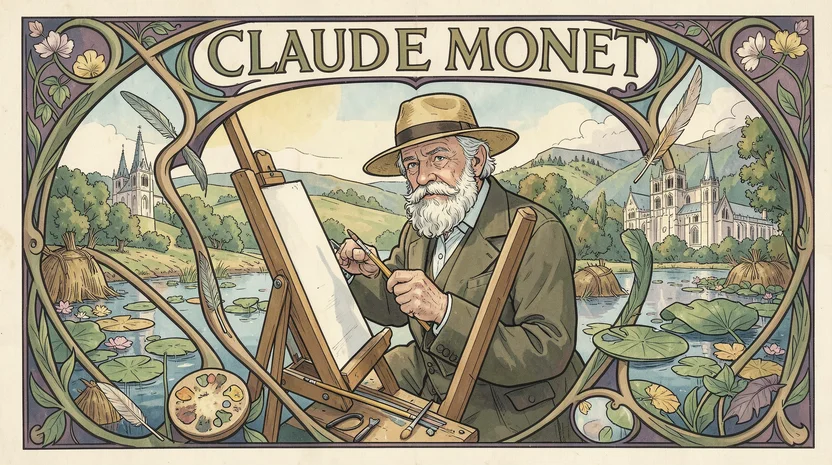
Claude Monet
Similar Quizzes
About this quiz
This quiz about Claude Monet features 10 questions. It was generated by one of our users May 24, 2026.
Prepare to immerse yourself in the vibrant world of a true titan of art! Before you stands a painter whose name is synonymous with capturing the fleeting beauty of light and color, forever transforming how we see the world around us. He was a master of capturing moments, from the dappled sunlight on water lilies to the misty mornings of his beloved Giverny. His revolutionary approach, characterized by loose brushstrokes and an emphasis on subjective perception, laid the groundwork for an entire artistic movement that continues to inspire generations.
This quiz will test your knowledge of this iconic artist, whose life and work are a testament to the power of observation and innovation. We'll explore his iconic series, the landscapes that fueled his imagination, and the enduring legacy of his groundbreaking techniques. So, sharpen your pencils and let your own perception guide you as we delve into the luminous universe of Claude Monet.
Claude Monet: The Master of Impressionism
Claude Monet (1840-1926) was a pivotal figure in the development of Impressionism, a radical art movement that revolutionized painting in the late 19th century. His lifelong dedication to capturing the fleeting effects of light and color on the natural world made him a true pioneer. This study material will delve into his life, artistic philosophy, key works, and enduring legacy.
1. Introduction: A Life Dedicated to Light
- Who was Monet? Oscar-Claude Monet was a French painter, a founder of the Impressionist movement, and arguably its most consistent practitioner.
- What is Impressionism? A movement that emphasized the impression of a moment, focusing on the transient effects of light and color, often painted outdoors (en plein air) with visible brushstrokes.
- Monet's Significance: He wasn't just a participant; he was a driving force. His name, derived from his painting Impression, Sunrise, became synonymous with the movement.
2. Early Life and Influences
- Birth and Childhood: Born in Paris, Monet moved to Le Havre, Normandy, at a young age. His early artistic talent was recognized by local artists.
- Early Mentors:
- Eugène Boudin: A landscape painter who encouraged Monet to paint outdoors and introduced him to the beauty of the Normandy coast. Boudin's influence was profound, teaching Monet to observe the sky and sea with fresh eyes.
- Johan Barthold Jongkind: A Dutch painter who further refined Monet's understanding of light and atmosphere.
- Paris and the Salon: Monet moved to Paris to study art, but found the rigid academic standards of the official Salon stifling. He sought a more personal and expressive approach.
3. The Birth of Impressionism
- The Salon des Refusés (1863): A pivotal event where artists rejected by the official Salon exhibited their work. This marked a rebellion against academic art and paved the way for new artistic ideas.
- The First Impressionist Exhibition (1874): Organized by Monet and other like-minded artists (Renoir, Degas, Pissarro, Sisley, Morisot), this exhibition was met with harsh criticism but was a landmark moment for the movement.
- Impression, Sunrise (1872): This painting, depicting the port of Le Havre at sunrise, was singled out by art critic Louis Leroy, who derisively coined the term "Impressionism" based on its title. Monet embraced the label.
4. Artistic Philosophy and Techniques
Monet's approach to painting was revolutionary. He sought to capture the experience of seeing, rather than a precise representation.
- Capturing Light and Atmosphere: This was Monet's obsession. He believed that light constantly changed the appearance of objects and that a painter's role was to record these ephemeral moments.
- Painting En Plein Air (Outdoors): To accurately depict light and its effects, Monet spent countless hours painting in the open air, directly observing his subject. This allowed him to capture the nuances of natural light and the vibrant colors of the environment.
- Visible Brushstrokes: Instead of smooth, blended surfaces, Monet used short, broken brushstrokes. This technique conveyed the sense of movement, vibration, and the shimmering quality of light. It also allowed colors to mix optically in the viewer's eye.
- Color Theory: Monet was deeply interested in how colors interacted. He often placed complementary colors next to each other to enhance their vibrancy and avoided the use of black, preferring to mix dark tones from other colors.
- Subject Matter: His subjects were often landscapes, seascapes, and scenes of modern life. He was particularly drawn to the effects of light on water, haystacks, cathedrals, and his own garden.
5. Key Periods and Series
Monet's career can be broadly divided into periods, with his later work characterized by extensive series paintings.
5.1 Early Works (Pre-Impressionism and Early Impressionism)
- Focus: Landscapes of Normandy, seascapes, and portraits.
- Characteristics: Still developing his style, but showing an increasing interest in light and atmosphere.
- Examples:
- The Terrace at Sainte-Adresse (1867)
- The Magpie (1868-69)
5.2 The Impressionist Years (1870s-1880s)
- Focus: Capturing the immediate sensory experience of a scene, often in series.
- Characteristics: Bold brushwork, vibrant colors, emphasis on light and atmosphere.
- Examples:
- Impression, Sunrise (1872)
- Rouen Cathedral Series (1890s) - See below for more detail
- Haystacks Series (1890-1891) - See below for more detail
5.3 Later Works and the Giverny Garden (1880s-1926)
- Focus: Monet's garden at Giverny became his primary inspiration. He dedicated himself to transforming it into a living work of art.
- Characteristics: Increasingly abstract, exploring the interplay of light, color, and form in his beloved water garden.
- Examples:
- Water Lilies Series (late 1890s - 1926) - See below for more detail
- The Japanese Bridge Series (late 1890s - early 1900s)
6. Iconic Series Paintings
Monet's fascination with how light changed the appearance of a subject led him to paint the same motif repeatedly under different conditions. These series allowed him to meticulously study and record these transformations.
6.1 The Haystacks Series (1890-1891)
- Subject: Stacks of harvested wheat left in the fields.
- Focus: Monet painted these haystacks over 25 times from different angles and at different times of day and year.
- What he captured: The subtle shifts in color and tone caused by the changing light – from the warm glow of sunrise to the cool shadows of dusk, and the variations of seasons.
- Significance: This series solidified his reputation for exploring the ephemeral nature of light and perception.
6.2 The Rouen Cathedral Series (1890s)
- Subject: The west facade of Rouen Cathedral.
- Focus: Monet set up his easel in a rented room opposite the cathedral and painted it over 30 times.
- What he captured: The monumental Gothic architecture seemed to dissolve and reappear under the influence of different light conditions. Sunrise, midday sun, foggy mornings, and evening hues all transformed the stone.
- Significance: This series is a testament to his ability to see beyond the solid form of the building and capture its atmospheric presence.
6.3 The Water Lilies Series (late 1890s - 1926)
- Subject: The water lily pond in his Giverny garden, along with his Japanese bridge and weeping willows.
- Focus: This became the lifelong project for Monet, spanning the last 30 years of his life. He created hundreds of paintings of his water garden.
- What he captured: As his eyesight deteriorated, his paintings became more abstract. The focus shifted to the surface of the water, the reflections of the sky and trees, and the floating lilies. The distinction between water, sky, and plant life blurred.
- Significance: The Water Lilies are perhaps his most famous works. They represent the culmination of his lifelong pursuit of capturing light and color, pushing the boundaries of representation towards abstraction. The vast scale of some of these murals in the Musée de l'Orangerie in Paris immerses the viewer in his vision.
7. Monet's Home and Garden at Giverny
- A Living Masterpiece: Monet's house and garden at Giverny, which he purchased in 1883, became his sanctuary and his greatest inspiration.
- The Water Garden: He meticulously designed and cultivated this area, creating the iconic lily pond, the Japanese bridge, and the weeping willows.
- The Flower Garden (Clos Normand): A riot of colorful flowers, planted in abundance and designed to be painted.
- Impact on his Art: Giverny provided him with a constant source of subjects, allowing him to study the subtle changes in light and atmosphere in his immediate surroundings.
8. Later Life and Legacy
- Failing Eyesight: In his later years, Monet suffered from cataracts, which significantly affected his color perception. This is often cited as a reason for the more abstract and intense color palettes in his late works.
- Continued Dedication: Despite his failing health, he continued to paint until his death.
- Enduring Influence: Monet's legacy is immense.
- Pioneer of Impressionism: He laid the groundwork for the movement and remained its most dedicated proponent.
- Influence on Modern Art: His emphasis on subjective experience, the expressive use of color, and the move towards abstraction influenced generations of artists, including the Abstract Expressionists.
- Popular Appeal: His works are among the most beloved and recognizable in art history, admired for their beauty, vibrancy, and emotional resonance.
9. Key Terms and Concepts to Remember
- Impressionism: Art movement focused on capturing fleeting moments of light and color.
- En Plein Air: Painting outdoors.
- Visible Brushstrokes: Short, broken strokes that convey movement and light.
- Optical Mixing: Colors mixing in the viewer's eye rather than on the palette.
- Series Paintings: Painting the same subject multiple times under different conditions.
- Light and Atmosphere: The core elements of Monet's artistic exploration.
10. Study Questions and Activities
- Compare and Contrast: Choose two paintings from Monet's Haystacks or Rouen Cathedral series and analyze how the light and color differ.
- Analyze a Work: Select one of Monet's iconic paintings (e.g., Water Lilies, Impression, Sunrise) and discuss its key Impressionist characteristics.
- Research: Investigate the critical reception of Impressionism during Monet's lifetime.
- Creative Response: Try your hand at painting outdoors, attempting to capture the light and colors of your surroundings using visible brushstrokes.
- Visit a Museum: If possible, visit a museum with a collection of Impressionist art to experience Monet's work firsthand.
Conclusion
Claude Monet was more than just a painter; he was a visionary who taught the world to see. His relentless pursuit of capturing the transient beauty of light and color transformed the landscape of art and continues to inspire awe and wonder centuries later. By understanding his life, his dedication to observation, and his innovative techniques, we can gain a deeper appreciation for the enduring power of his Impressionist masterpieces.