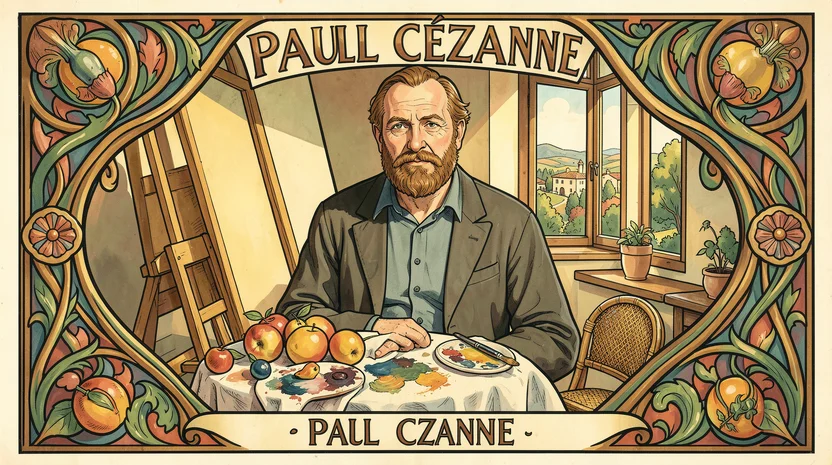
Paul Cézanne
Similar Quizzes
About this quiz
This quiz about Paul Cézanne features 10 questions. It was generated by one of our users February 24, 2026.
Prepare to delve into the world of a true artistic revolutionary! Our quiz today is dedicated to Paul Cézanne, a French painter whose groundbreaking work bridged the gap between Impressionism and Cubism, forever altering the course of modern art. Often hailed as the "father of modern art," Cézanne dared to see the world not just as a fleeting impression, but as a series of geometric forms waiting to be dissected and reassembled. His meticulous approach to capturing the essence of his subjects, from the rolling hills of Provence to the simple stillness of a fruit bowl, challenged conventional notions of perspective and color.
Cézanne's influence is undeniable, shaping the visions of artists like Picasso and Matisse who would go on to build upon his radical explorations. He sought to reveal the underlying structure of nature, breaking down forms into their fundamental shapes and applying paint with a deliberate, almost architectural, touch. So, sharpen your pencils and ready your minds, as we test your knowledge of this pivotal figure whose relentless pursuit of artistic truth continues to inspire and provoke. Are you ready to explore the genius of Paul Cézanne?
**Paul Cézanne: The Father of Modern Art**
Paul Cézanne (1839-1906) was a French artist who, despite limited recognition during his lifetime, is now hailed as one of the most pivotal figures in the history of art. His innovative approach to form, color, and perspective fundamentally reshaped artistic conventions, paving the way for Cubism and influencing generations of artists. This study material will delve into his life, artistic development, key themes, and enduring legacy.
**I. Early Life and Influences (1839-1870s)**
Birth and Background:
- Born in Aix-en-Provence, France, a region that would profoundly influence his artistic vision.
- His father, Louis Auguste Cézanne, was a successful banker who initially disapproved of his son's artistic aspirations, pushing him towards law.
- Cézanne's mother, Anne Elisabeth Honorine Aubert, was a strong supporter of his artistic inclinations.
Education and Early Training:
- Studied law at the University of Aix-en-Provence but continued to pursue his passion for drawing and painting in secret.
- Attended drawing classes at the École de Dessin in Aix.
- Moved to Paris in 1861 to study at the Académie Suisse, where he met Camille Pissarro, a fellow artist who became a crucial mentor and friend.
The Impressionist Connection:
- Cézanne exhibited with the Impressionists, sharing their interest in capturing fleeting moments and the effects of light.
- He participated in their exhibitions, including the first Impressionist exhibition in 1874.
- However, Cézanne's approach differed significantly. While Impressionists focused on the ephemeral, Cézanne sought a more solid and enduring structure in his subjects. He famously stated, "I want to make of Impressionism something solid and durable, like the art of the museums."
Early Artistic Style:
- His early works were often characterized by a darker palette, influenced by the Old Masters he studied at the Louvre.
- Themes included portraits, still lifes, and scenes of his native Provence.
- Examples: The Abduction (c. 1867-1871), The Smoker (c. 1866).
**II. Artistic Development and the Search for Form (1870s-1900s)**
The Influence of Pissarro:
- Pissarro encouraged Cézanne to experiment with brighter colors and broken brushwork, typical of Impressionism.
- Their collaborations in the countryside around Pontoise and Auvers-sur-Oise were instrumental in Cézanne's development.
The Birth of a Unique Style:
- Cézanne began to move away from purely optical sensations and towards a more analytical and constructive approach to painting.
- He developed a technique of applying paint in small, distinct brushstrokes, often described as "constructive strokes." These strokes built up form and volume, creating a sense of solidity.
- He was deeply interested in geometric underlying structures of nature. He believed that all natural forms could be reduced to basic geometric shapes like the sphere, cone, and cylinder. This idea would later be famously summarized by Henri Matisse as: "Cézanne is the father of us all."
Key Themes and Subjects:
- Landscapes of Provence: The Mont Sainte-Victoire became an iconic motif, painted repeatedly from various viewpoints and in different light conditions. These landscapes were not just depictions but explorations of space, form, and color.
- Still Lifes: Cézanne elevated the still life to a profound level of artistic inquiry. He meticulously arranged everyday objects, focusing on their volumetric qualities, the way light interacted with their surfaces, and the relationships between them. His still lifes are characterized by their structural integrity and harmonious compositions.
- Portraits: His portraits, though less frequent than landscapes or still lifes, are deeply psychological and often convey a sense of quiet introspection.
- Bathers: His series of Bathers (Les Grandes Baigneuses) represent a culmination of his artistic theories, exploring the human form in relation to the landscape and the interplay of solid volumes.
Innovative Techniques:
- Multiple Viewpoints: Cézanne often depicted objects from slightly different angles within the same painting, anticipating Cubist fragmentation. This challenged the traditional single-point perspective.
- Color as Structure: He used color not just to describe light but to build form and create spatial relationships. Colors were applied in planes, with warm colors advancing and cool colors receding.
- Flattening of Space: Paradoxically, while building volume, Cézanne also flattened the picture plane, emphasizing the two-dimensionality of the canvas.
**III. Key Works and Their Significance**
Mont Sainte-Victoire Series (1880s-1900s):
- These paintings are perhaps Cézanne's most famous. He viewed the mountain not just as a subject but as a complex interplay of forms and colors, bathed in the light of Provence.
- The series demonstrates his evolving approach to landscape painting, moving from direct observation to a more internalized and structural interpretation.
Still Life with Apples and Oranges (c. 1895-1900):
- A quintessential example of his still life work. The fruit is rendered with a palpable solidity, and the arrangement of objects creates a dynamic interplay of forms and perspectives.
- The subtle shifts in viewpoint and the deliberate placement of objects challenge the viewer to engage with the painting in a new way.
The Card Players (c. 1890-1892):
- This series of paintings depicts Provençal peasants engaged in a game of cards. Cézanne portrays them with a profound sense of dignity and monumentality.
- The figures are rendered as solid, volumetric forms, and the composition is carefully balanced, emphasizing the quiet intensity of the scene.
The Large Bathers (Les Grandes Baigneuses) (c. 1898-1905):
- This unfinished masterpiece is seen as a synthesis of his artistic concerns: the human form, landscape, and the exploration of color and structure.
- The figures are integrated into the landscape, appearing as monumental, almost architectural elements.
**IV. Later Life and Legacy**
Return to Aix-en-Provence:
- Frustrated by the Parisian art scene and seeking solitude, Cézanne returned to Aix-en-Provence in the 1880s.
- He lived a relatively reclusive life, dedicating himself to his art.
Limited Recognition During His Lifetime:
- Despite his profound artistic innovations, Cézanne was largely overlooked by the mainstream art world during his life.
- He was often seen as eccentric and difficult.
The Turning Point:
- The posthumous exhibition of his work at the Salon d'Automne in Paris in 1907, a year after his death, was a revelation.
- This exhibition, alongside the writings and advocacy of younger artists and critics, cemented his reputation as a revolutionary figure.
Influence on Modern Art:
- Cubism: Georges Braque and Pablo Picasso, the pioneers of Cubism, were directly inspired by Cézanne's exploration of multiple viewpoints and the breakdown of forms into geometric shapes. They referred to him as their "father."
- Fauvism: The Fauvist movement, with its bold and expressive use of color, also drew inspiration from Cézanne's innovative approach to color as a structural element.
- Abstract Art: His emphasis on the underlying structure and formal qualities of his subjects laid groundwork for the development of abstract art.
Enduring Impact:
- Cézanne's work continues to be studied and admired for its intellectual rigor, its profound exploration of visual perception, and its enduring beauty.
- He is celebrated for his ability to see the underlying geometric order in nature and to translate that vision onto the canvas with unparalleled skill and insight.
**V. Key Concepts to Remember**
- Constructive Strokes: His characteristic brushwork that builds form and volume.
- Geometric Reduction: The idea that natural forms can be broken down into spheres, cones, and cylinders.
- Multiple Viewpoints: Depicting subjects from slightly different angles simultaneously.
- Color as Structure: Using color to define form and create spatial relationships.
- Solidity and Enduring Form: His quest to create art that possessed a tangible and lasting presence.
- The Father of Modern Art: His fundamental role in bridging Impressionism and the subsequent avant-garde movements.
**VI. Further Study and Discussion Points**
- Compare and contrast Cézanne's approach to still life with that of earlier masters like Chardin.
- Analyze how Cézanne's treatment of space differs from traditional Renaissance perspective.
- Discuss the relationship between Cézanne's art and the natural environment of Provence.
- Explore the direct influence of Cézanne's work on specific Cubist paintings by Picasso and Braque.
- Consider the psychological impact of Cézanne's portraits.
- Research the critical reception of Cézanne's work during his lifetime and the reasons for its eventual acclaim.
Paul Cézanne's legacy is not merely that of a painter, but of a visionary who fundamentally altered our understanding of how we see and represent the world. His relentless pursuit of truth in form and color continues to inspire and challenge artists and viewers alike.