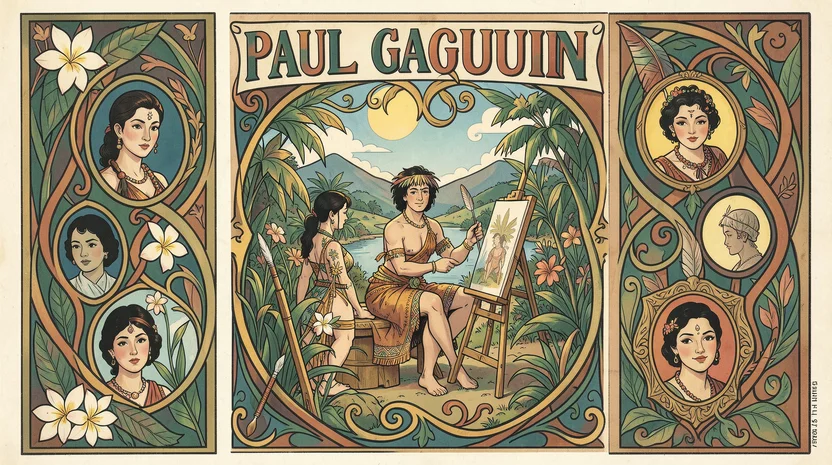
Paul Gauguin
Similar Quizzes
About this quiz
This quiz about Paul Gauguin features 10 questions. It was generated by one of our users February 13, 2026.
Paul Gauguin: The Artist Who Escaped Civilization
Paul Gauguin was a French post-impressionist painter who shocked the art world by abandoning both his successful banking career and European society in pursuit of artistic authenticity. Born in 1848, Gauguin initially lived a conventional bourgeois life in Paris, working as a stockbroker and collecting impressionist paintings as a hobby. However, his passion for art eventually consumed him, leading to one of the most dramatic career changes in art history. When he picked up a paintbrush professionally in his thirties, he was already determined to break free from the artistic traditions of his time.
Driven by a desire to escape what he saw as the corruption and artificiality of Western civilization, Gauguin embarked on a series of journeys that would define both his art and his legend. He first sought inspiration in rural Brittany, then made his famous voyage to Tahiti in 1891, where he created some of his most celebrated works. His bold use of color, simplified forms, and symbolic approach to painting influenced countless artists and helped pave the way for modern art movements like Fauvism and Expressionism. Though he died in poverty in the Marquesas Islands in 1903, Gauguin's quest for artistic freedom and his exotic, dreamlike paintings of Polynesian life have made him one of art history's most fascinating and controversial figures.
Test your knowledge about this pioneering artist who traded Wall Street for the South Pacific in search of artistic truth!
Paul Gauguin: Pioneer of Modern Art
Table of Contents
- Introduction
- Early Life and Background
- Artistic Journey and Evolution
- Major Periods and Influences
- Famous Works
- Artistic Style and Techniques
- Personal Life and Relationships
- Legacy and Impact
- Study Questions
- Further Reading
Introduction
Eugène Henri Paul Gauguin (1848-1903) was a French Post-Impressionist artist whose bold use of color and distinctive style profoundly influenced modern art. Often considered a pioneer of Primitivism and Symbolism, Gauguin's work bridged the gap between Impressionism and the avant-garde movements of the 20th century.
"Art is an abstraction; derive this abstraction from nature while dreaming before it, and think more of the creation which will result than of nature." - Paul Gauguin
Key Facts at a Glance
- Born: June 7, 1848, Paris, France
- Died: May 8, 1903, Atuona, Hiva Oa, Marquesas Islands
- Movement: Post-Impressionism, Symbolism, Primitivism
- Famous for: Bold colors, simplified forms, exotic subjects
- Notable works: The Yellow Christ, When Will You Marry?, Where Do We Come From? What Are We? Where Are We Going?
Early Life and Background
Childhood and Family
Paul Gauguin was born into a middle-class Parisian family with diverse cultural influences:
- Father: Clovis Gauguin, a liberal journalist
- Mother: Aline Chazal, of Spanish-Peruvian descent
- Grandmother: Flora Tristan, a prominent socialist activist and writer
Formative Experiences
Peru (1849-1855): After his father's death, young Paul lived with his mother's wealthy relatives in Lima, Peru. This early exposure to non-European culture would later influence his artistic vision.
Maritime Career (1865-1871): Gauguin served in the French merchant marine and later the navy, traveling to various ports and experiencing different cultures.
Business Career
Before becoming a full-time artist, Gauguin worked as:
- Stockbroker in Paris (1872-1883)
- Art collector and Sunday painter
- Member of the bourgeois society with a comfortable income
Artistic Journey and Evolution
From Businessman to Artist
The Transition (1870s-1883)
- Started painting as a hobby while working in finance
- Collected works by Camille Pissarro, Paul Cézanne, and other Impressionists
- Met Pissarro, who became his mentor and introduced him to Impressionist techniques
- Participated in Impressionist exhibitions from 1879-1886
The Great Decision (1883)
In 1883, Gauguin made the life-changing decision to abandon his lucrative career and pursue art full-time. This decision led to:
- Financial hardship for his family
- Strain on his marriage to Mette-Sophie Gad
- Complete dedication to artistic development
Artistic Mentors and Influences
| Mentor/Influence | Period | Impact |
|---|---|---|
| Camille Pissarro | 1870s-1880s | Impressionist techniques, plein air painting |
| Paul Cézanne | 1880s | Structural approach to form and color |
| Japanese Prints | 1880s-1890s | Flat color planes, bold outlines |
| Breton Folk Art | 1886-1894 | Simplified forms, spiritual themes |
Major Periods and Influences
1. Impressionist Period (1870s-1885)
Characteristics:
- Traditional Impressionist techniques
- Focus on light and atmosphere
- Landscape and still-life subjects
- Influence of Pissarro evident
Key Work: The Seine at the Pont d'Iéna (1875)
2. Pont-Aven Period (1886-1888, 1889-1890)
Gauguin's time in Pont-Aven, Brittany marked a crucial turning point:
Revolutionary Developments:
- Development of Synthetism (synthesis of observation, memory, and emotion)
- Cloisonnism technique (bold outlines separating color areas)
- Collaboration with Émile Bernard and other avant-garde artists
- Rejection of Impressionist naturalism
The Pont-Aven School: Gauguin became the leader of a group of artists who gathered in this small Breton village, seeking:
- Authentic, primitive culture
- Escape from modern industrial society
- Spiritual and artistic renewal
Key Works:
- Vision After the Sermon (1888)
- The Yellow Christ (1889)
3. Arles Period (1888)
The Van Gogh Collaboration: Gauguin spent two months with Vincent van Gogh in Arles, resulting in:
- Intense artistic exchange
- Mutual influence on each other's work
- Personal conflicts and van Gogh's mental breakdown
- End of their friendship
4. First Tahitian Period (1891-1893)
Seeking the "primitive" and exotic, Gauguin traveled to Tahiti:
Motivations:
- Escape European civilization
- Find "authentic" primitive culture
- Achieve artistic breakthrough
- Financial necessity (cheaper living)
Artistic Developments:
- Bold, non-naturalistic color
- Simplified, monumental forms
- Synthesis of Polynesian and European artistic traditions
- Mythological and everyday subjects
Key Works:
- When Will You Marry? (1892)
- The Spirit of the Dead Watching (1892)
5. Return to France (1893-1895)
Brief return to Paris and Brittany:
- Exhibition of Tahitian works (limited success)
- Financial difficulties
- Inheritance from uncle allowed return to Tahiti
6. Second Tahitian Period (1895-1901)
Mature Style Development:
- Masterpiece creation period
- Synthesis of all previous influences
- Philosophical and spiritual themes
- Declining health but artistic vigor
Key Work: Where Do We Come From? What Are We? Where Are We Going? (1897-1898)
7. Marquesas Period (1901-1903)
Final phase in the Marquesas Islands:
- Continued artistic production despite illness
- Conflicts with colonial authorities
- Death on May 8, 1903
Famous Works
*Vision After the Sermon (Jacob Wrestling with the Angel)* (1888)
Significance: Revolutionary work marking Gauguin's break from Impressionism
Technical Innovations:
- Cloisonnism: Bold black outlines
- Non-naturalistic color: Vermillion ground
- Symbolic content: Biblical scene in Breton setting
- Compositional boldness: Diagonal tree trunk dividing sacred and profane
Interpretation: Represents the power of faith and imagination over reality
*The Yellow Christ* (1889)
Context: Painted in Pont-Aven, inspired by a medieval crucifix in a local chapel
Artistic Elements:
- Simplified forms: Reduction to essential elements
- Symbolic color: Yellow representing divine light and spiritual transformation
- Cultural synthesis: Christian iconography in Breton landscape
- Emotional expression: Melancholy and spiritual yearning
*When Will You Marry? (Nafea Faa Ipoipo)* (1892)
Historical Note: Sold for approximately $300 million in 2015, making it one of the most expensive paintings ever sold
Artistic Features:
- Exotic Orientalism: Romanticized view of Tahitian culture
- Decorative style: Influenced by Japanese prints and Polynesian art
- Color harmony: Rich, saturated hues
- Cultural appropriation questions: Modern criticism of Gauguin's colonial perspective
*Where Do We Come From? What Are We? Where Are We Going?* (1897-1898)
Gauguin's Testament: Considered his masterpiece and philosophical statement
Composition Analysis:
- Right to left narrative: Life cycle from birth to death
- Symbolic figures: Each represents different life stages
- Color symbolism: Blues for mystery, yellows for divine, earth tones for mortality
- Scale: Monumental size (139 cm × 375 cm) emphasizing importance
Philosophical Themes:
- Existential questions about human condition
- Synthesis of Christian and Polynesian spiritual concepts
- Artist's personal meditation on life and death
Artistic Style and Techniques
Color Theory and Usage
Revolutionary Color Approach:
- Arbitrary color: Colors chosen for emotional/symbolic rather than naturalistic reasons
- Pure pigments: Often applied directly from tube without mixing
- Color contrasts: Bold juxtapositions for maximum visual impact
- Symbolic associations: Colors carry specific meanings (yellow=divine, red=passion, etc.)
Compositional Techniques
Cloisonnism
- Definition: Technique using bold outlines to separate color areas
- Origin: Inspired by medieval cloisonné enamel work
- Effect: Creates decorative, stained-glass-like appearance
- Influence: Adopted by other Post-Impressionist artists
Synthetism
- Concept: Synthesis of three elements:
- Observation of nature
- Memory of previous experiences
- Emotion and imagination
- Goal: Create art that goes beyond mere representation
- Legacy: Influenced abstract art development
Drawing and Form
Characteristics:
- Simplified forms: Reduction to essential shapes
- Flattened perspective: Rejection of Renaissance spatial illusion
- Decorative emphasis: Pattern and design over naturalistic representation
- Primitivist influence: Inspiration from non-Western art forms
Personal Life and Relationships
Family and Marriage
Marriage to Mette-Sophie Gad (1873):
- Danish woman from bourgeois family
- Five children together
- Marriage strained by Gauguin's career change
- Separation when family moved to Denmark (1884)
- Lifelong correspondence but limited contact
Key Relationships
Vincent van Gogh
- Period: 1888 collaboration in Arles
- Dynamics: Mutual respect but personality conflicts
- Artistic impact: Both influenced each other's work
- Tragic end: Van Gogh's mental breakdown ended friendship
Émile Bernard
- Role: Young artist and theoretical collaborator
- Contribution: Co-developed Synthetism and Cloisonnism
- Relationship: Initially close, later competitive
- Legacy: Helped establish Gauguin's theoretical foundations
Charles Laval
- Connection: Fellow artist and travel companion
- Shared experiences: Traveled together to Panama and Martinique (1887)
- Artistic exchange: Mutual influence during tropical period
Tahitian Relationships
Teha'amana (first Tahitian wife):
- 13-year-old girl who became his companion
- Subject of several paintings
- Relationship reflects colonial power dynamics
Pau'ura (second Tahitian wife):
- Mother of his daughter Aline
- Continued relationship until his death
Personality and Character
Complex Individual:
- Arrogant and self-promoting: Often exaggerated his primitive lifestyle
- Intellectually curious: Well-read in literature and philosophy
- Rebellious: Rejected bourgeois society and artistic conventions
- Contradictory: Sought primitive life while maintaining European cultural superiority
Legacy and Impact
Influence on Modern Art Movements
Fauvism
- Color liberation: Arbitrary use of color influenced Henri Matisse and André Derain