Spruce Trees
Similar Quizzes
About this quiz
This quiz about Spruce Trees features 10 questions. It was generated by one of our users February 21, 2026.
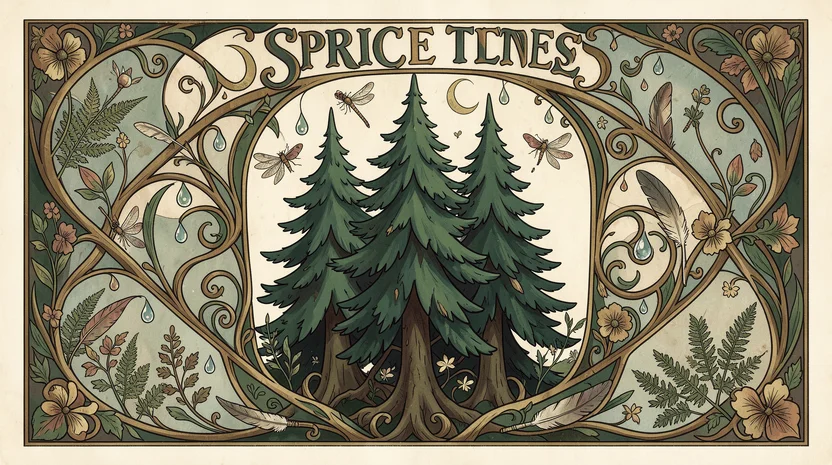
Prepare to test your knowledge of one of nature's most iconic and resilient evergreens! Spruce trees, with their distinctive conical shape and fragrant needles, have graced landscapes across the Northern Hemisphere for millennia. From the towering Sitka spruce of the Pacific Northwest to the hardy Norway spruce found in European forests, these majestic conifers play a vital role in their ecosystems, providing shelter and sustenance for countless creatures. They are not just beautiful to behold; their wood has been a cornerstone of human industry for centuries, used for everything from musical instruments to paper.
So, how much do you really know about these stoic giants? Are you familiar with their unique reproductive structures, their impressive lifespan, or the specific adaptations that allow them to thrive in diverse climates? Get ready to delve into the fascinating world of spruce trees and discover the secrets held within their sturdy branches and needle-laden boughs. This quiz will challenge you to identify their characteristics, understand their ecological importance, and appreciate the silent strength of these enduring evergreens.
Spruce Trees: A Comprehensive Study
Spruce trees, belonging to the genus Picea, are magnificent evergreen conifers that grace forests across the Northern Hemisphere. Known for their distinctive conical shape, sturdy branches, and fragrant needles, spruces play vital ecological roles and hold significant cultural and economic importance. This study material will delve into the fascinating world of spruces, covering their biology, ecology, distribution, uses, and conservation.
1. Introduction to Spruce Trees
Spruce trees are a cornerstone of many boreal and montane ecosystems. They are characterized by their:
- Evergreen Nature: Their needles remain green throughout the year, providing essential food and shelter for wildlife during harsh winters.
- Conical Shape: This classic Christmas tree silhouette is an adaptation to shed snow efficiently, preventing branch breakage.
- Needles: Typically sharp and square or rectangular in cross-section, they are attached to the twig individually by a small, woody peg.
- Cones: Spruce cones are typically pendulous (hanging downwards) and have thin, papery scales.
2. Taxonomy and Classification
The genus Picea is part of the Pinaceae family, which also includes pines, firs, and larches. There are approximately 35 recognized species of spruce, with variations in size, needle characteristics, and cone morphology.
Key Characteristics of the Genus Picea:
- Needle Attachment: Each needle is attached to the branch by a persistent, woody peg (sterigma). When a needle falls, this peg remains on the twig, giving spruce twigs a rough texture. This is a key differentiator from firs, where needles leave a smooth scar.
- Cone Structure: Spruce cones are typically cylindrical and hang downwards. They mature and disintegrate on the tree, releasing their winged seeds.
- Buds: Spruce buds are usually pointed and resinous.
3. Anatomy and Morphology
Understanding the physical characteristics of spruce trees is crucial for identification and appreciating their adaptations.
3.1. Tree Structure
- Trunk: Spruces generally have a straight, single trunk that can reach impressive heights.
- Branches: Branches are typically arranged in whorls, contributing to the tree's symmetrical, conical form. Young spruces have dense foliage, while older trees may become more open at the crown.
- Root System: Spruces often have shallow, widespread root systems, making them susceptible to windthrow, especially in shallow soils or areas with high winds.
3.2. Needles
- Shape and Cross-section: Needles are typically square or rectangular in cross-section, giving them a stiff, somewhat prickly feel.
- Attachment: As mentioned, they are attached by woody pegs.
- Arrangement: Needles are spirally arranged around the twig.
- Color: Most spruces have green needles, though some species may exhibit bluish or silvery hues due to a waxy coating (glaucousness).
- Stomata: Needles have stomata (pores for gas exchange) that are often visible as fine lines of dots on the needle surface.
3.3. Cones
- Orientation: Cones are pendulous (hang downwards).
- Scales: Cone scales are typically thin, papery, and often have irregular margins. Unlike fir cones, spruce cones do not disintegrate on the tree but fall off intact.
- Maturation: Cones mature in a single season.
- Seeds: Seeds are small, winged, and are dispersed by wind.
3.4. Bark
- Young Trees: Bark is typically thin, smooth, and grayish or reddish-brown.
- Mature Trees: Bark becomes thicker, scaly, or furrowed, with color variations depending on the species.
4. Major Spruce Species and Their Distribution
Spruces are found in the cooler regions of the Northern Hemisphere, from high altitudes in temperate zones to the vast boreal forests. Here are some of the most prominent species:
4.1. White Spruce (*Picea glauca*)
- Distribution: Widespread across boreal North America, from Alaska to Newfoundland.
- Characteristics: Medium to large tree, often with a narrow, spire-like crown. Needles are relatively short, stiff, and have a bluish-green color. Cones are slender and light brown.
- Habitat: Prefers well-drained soils and can tolerate a range of conditions.
4.2. Black Spruce (*Picea mariana*)
- Distribution: Common throughout boreal North America, often found in wetter, poorer soils.
- Characteristics: Smaller, slower-growing tree than white spruce. Needles are short, dark green, and often curved. Cones are small, dark, and often remain on the tree for many years.
- Habitat: Thrives in bogs, muskegs, and poorly drained areas. Its cones often require fire to open and release seeds.
4.3. Norway Spruce (*Picea abies*)
- Distribution: Native to Europe, extending from Norway to the Balkans. Widely planted as an ornamental and for timber.
- Characteristics: One of the largest spruces, capable of reaching over 200 feet. Needles are dark green and relatively long. Cones are large and pendulous.
- Habitat: Prefers moist, well-drained soils and cool climates.
4.4. Sitka Spruce (*Picea sitchensis*)
- Distribution: Coastal regions of the Pacific Northwest of North America, from Alaska to Northern California.
- Characteristics: The largest spruce species, capable of immense size. Needles are sharp, stiff, and bluish-green. Cones are large and cylindrical.
- Habitat: Requires high rainfall and moist conditions, often found in coastal rainforests.
4.5. Engelmann Spruce (*Picea engelmannii*)
- Distribution: Rocky Mountains of western North America, at high elevations.
- Characteristics: Tall, slender tree with a narrow crown. Needles are soft, bluish-green, and have a pleasant aroma. Cones are small and purplish.
- Habitat: Dominant species in high-elevation subalpine forests.
5. Ecology and Adaptations
Spruce trees are well-adapted to their often harsh environments.
5.1. Cold Tolerance
- Needle Structure: The waxy coating on needles reduces water loss, crucial in frozen conditions.
- Conical Shape: Efficiently sheds snow, preventing damage to branches and the tree.
- Resin Production: Helps seal wounds and deter pests in cold climates.
5.2. Soil Preferences
- Boreal Spruces: Black spruce, in particular, is adapted to acidic, waterlogged, and nutrient-poor soils, often forming peatlands.
- Other Spruces: Many species prefer well-drained, loamy soils.
5.3. Fire Adaptations
- Black Spruce: Its cones often require the heat of a fire to open and release seeds. This allows it to regenerate quickly after a fire.
- Other Spruces: While not as fire-dependent as black spruce, some species can tolerate low-intensity fires, and their seeds can colonize burned areas.
5.4. Wildlife Interactions
- Food Source: Spruce needles and seeds are a food source for various animals, including birds (like crossbills) and small mammals.
- Habitat: Dense spruce forests provide shelter and nesting sites for numerous species.
6. Uses of Spruce Trees
Spruces have been utilized by humans for centuries.
6.1. Timber Industry
- Wood Properties: Spruce wood is lightweight, strong, and has a straight grain. It is also relatively free of knots.
- Applications:
- Construction: Lumber for framing, sheathing, and general construction.
- Pulp and Paper: A primary source of wood pulp for paper production.
- Musical Instruments: Highly valued for soundboards in guitars, violins, and pianos due to its resonance.
- Aircraft and Boats: Historically used in aircraft construction and for boat hulls due to its strength-to-weight ratio.
- Poles and Pilings: Used for utility poles and structural pilings.
6.2. Christmas Trees
- Aesthetic Appeal: Their classic conical shape, symmetrical branching, and pleasant fragrance make them ideal Christmas trees.
- Popular Species: Norway spruce, white spruce, and blue spruce (a cultivar of white spruce) are commonly used.
6.3. Medicinal and Traditional Uses
- Resin: Spruce resin has been used historically for its antiseptic and wound-healing properties.
- Needles: Spruce needle tea is rich in vitamin C and was used to prevent scurvy.
6.4. Ecological Services
- Carbon Sequestration: As large evergreen trees, spruces are significant carbon sinks, helping to mitigate climate change.
- Soil Stabilization: Their root systems help prevent soil erosion.
- Water Regulation: Spruce forests play a role in regulating water cycles.
7. Threats and Conservation
Despite their widespread distribution, some spruce populations face challenges.
7.1. Threats
- Climate Change: Shifting climate patterns can lead to increased stress from drought, pests, and diseases. Warmer temperatures can also favor the spread of invasive species.
- Pests and Diseases: Spruce bark beetles, spruce budworm, and various fungal diseases can cause significant damage and mortality.
- Habitat Loss and Fragmentation: Deforestation for agriculture, urbanization, and logging can reduce spruce habitats.
- Acid Rain: Historically, acid rain has damaged spruce forests, particularly in Europe.
7.2. Conservation Efforts
- Sustainable Forestry Practices: Managing forests for long-term health and productivity, including selective logging and reforestation.
- Pest and Disease Management: Monitoring and implementing strategies to control outbreaks.
- Protected Areas: Establishing national parks and wilderness areas to conserve vital spruce ecosystems.
- Climate Change Adaptation: Researching and implementing strategies to help spruce forests adapt to changing environmental conditions.
- Restoration Projects: Reforesting degraded areas with native spruce species.
8. Fun Facts About Spruces
- The "Christmas Tree" Silhouette: The iconic Christmas tree shape is a result of how spruce branches grow in whorls, with each year's growth forming a new tier.
- Resin for Glue: Historically, spruce resin was used as a waterproof adhesive for various purposes.
- Long-Lived Trees: Some spruce species can live for hundreds of years, with the oldest recorded Norway spruce estimated to be over 900 years old.
- "Singing" Trees: In some areas, strong winds passing through the dense needles of spruce trees can create a distinctive whistling or "singing" sound.
9. Study Questions and Activities
To reinforce your learning, consider the following:
- Identification Challenge: Find a spruce tree in your local area and try to identify its species using its needle arrangement, cone characteristics, and bark.
- Compare and Contrast: Create a Venn diagram comparing and contrasting two different spruce species (e.g., White Spruce and Black Spruce).
- Ecological Role: Research the role of spruce trees in the food web of a specific ecosystem (e.g., the boreal forest).
- Economic Impact: Investigate the economic importance of spruce timber in your region or a country where spruces are prevalent.
- Conservation Debate: Research a specific threat facing spruce trees and propose a conservation strategy to address it.
Conclusion
Spruce trees are more than just beautiful evergreens; they are vital components of our planet's ecosystems, providing habitat, regulating climate, and offering invaluable resources to humanity. By understanding their biology, ecology, and the challenges they face, we can better appreciate and protect these magnificent trees for future generations.